


Hair loss affects millions of women and can have a profound impact on appearance, self-confidence, and quality of life. Fortunately, modern female hair transplant surgery offers a permanent solution for many women experiencing thinning hair, hairline recession, traction alopecia or localized baldness.
Hair transplant for women is a proven surgical option that restores density to thinning or bare areas of the scalp by relocating healthy follicles from a stable donor zone. Candidacy depends on the pattern of hair loss; women with localized thinning, such as traction alopecia or a receding hairline, tend to be stronger candidates than those with diffuse thinning, which limits available donor hair. However, many women remain good candidates, and a consultation with a board-certified plastic surgeon is the best way to find out.
Using advanced techniques such as Follicular Unit Extraction (FUE) and ARTAS® Robotic Hair Transplantation, healthy hair follicles are transplanted from a stable donor area to regions affected by hair loss, creating natural-looking, long-lasting results.
Women experience hair loss differently from men, which means candidacy requirements, technique selection, recovery, and results also differ. This guide covers everything a woman needs to know before scheduling her first consultation, from causes and candidacy to cost and recovery so that you can arrive at your appointment with confidence.
Quick Answer: Can Women Get Hair Transplants?
Yes. Women can absolutely undergo hair transplant surgery when they have sufficient donor hair and a hair loss pattern suitable for transplantation.
The best candidates often include women with:
- Female pattern hair loss with localized thinning
- Traction alopecia
- Receding or naturally high hairlines
- Hair loss from trauma or surgical scars
- Eyebrow hair loss
- Hairline feminization goals
Women with diffuse thinning across the entire scalp may require additional evaluation, as donor hair quality plays a critical role in achieving successful outcomes.
A consultation with a board-certified plastic surgeon experienced in female hair restoration is the most reliable way to determine candidacy.
At Dr. Adrian Lo’s Philadelphia and South Jersey practices, every treatment plan is customized to the patient’s unique hair loss pattern, donor hair quality, and long-term goals. Understanding your options begins with understanding why female hair loss occurs and whether a hair transplant is the right solution.
Why Female Hair Loss Is Different — And Why It Matters for Treatment
Female hair loss differs significantly from male pattern baldness.
The key difference between female and male hair loss is the pattern. Men frequently develop a receding hairline and defined bald spots. Women more commonly experience gradual thinning across the crown, mid-scalp, or part line. This distinction directly affects whether hair restoration for women is appropriate, the need for a more detailed evaluation of donor hair availability, and which technique will produce the best outcome.
Female hair restoration begins with understanding why women lose hair in the first place, and how that pattern differs from male hair loss. The most common cause of female pattern hair loss (androgenetic alopecia), also called female pattern baldness, is progressive thinning of hair across the crown and midscalp. At the same time, the frontal hairline often remains intact.
Other common causes of female hair loss include:
- Traction alopecia from chronic tension caused by tight hairstyles
- Hormonal changes related to pregnancy, menopause, PCOS, and thyroid disorders
- Telogen effluvium: A temporary shedding phase triggered by illness, stress, medications, surgery or hormonal changes
- Scarring alopecias: Inflammatory conditions that permanently damage hair follicles and may require specialized treatment.
Because the underlying cause directly impacts candidacy and treatment selection, an accurate diagnosis is one of the most important parts of the hair restoration process.
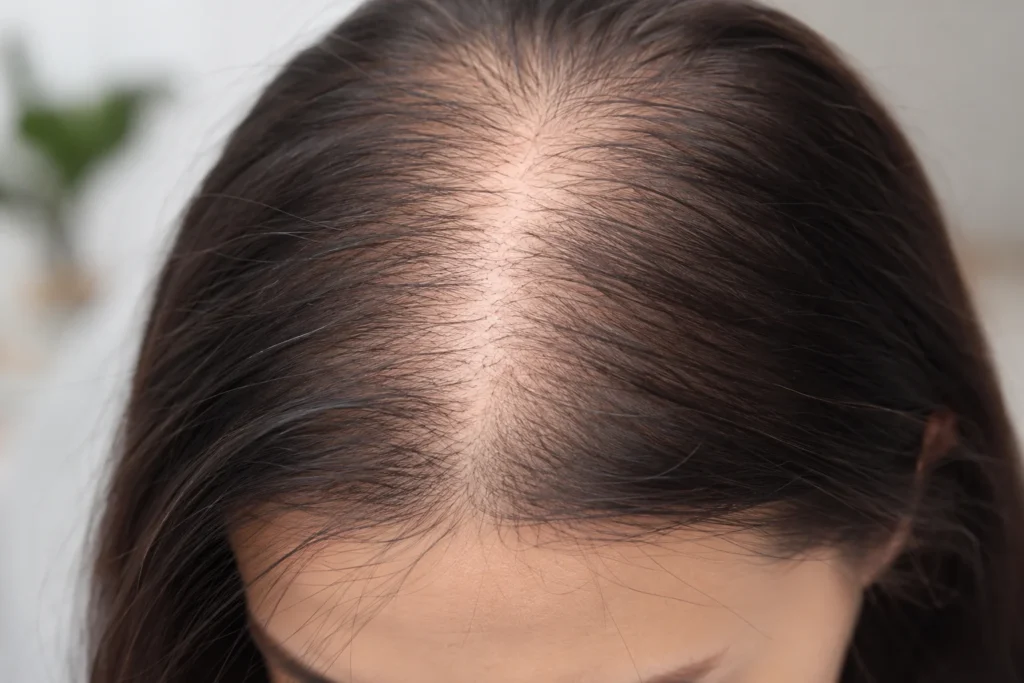
Hair Transplant for Women: What Options are Available?
A female hair transplant is a surgical procedure that relocates healthy follicles from a stable donor area to regions of thinning or loss. The transplanted follicles take root in their new location and grow naturally, providing long-lasting results for the right candidate.
Four different techniques are available in hair transplant procedures for women: Follicular Unit Extraction (FUE), Follicular Unit Transplantation (FUT), ARTAS robotic FUE, and Platelet-Rich Plasma (PRP) therapy. Understanding the differences helps patients know what to expect and which approach a plastic surgeon might recommend.
Follicular Unit Extraction (FUE)
FUE is the most widely performed hair transplant technique for women. Individual follicular units are extracted from the donor area, typically the back and sides of the scalp, and transplanted into thinning zones on the crown, hairline, or part line. The procedure is performed as an outpatient under local anesthesia, usually in a single session.
Women experiencing thinning along the hairline or crown, or a widening part line, are frequently excellent FUE candidates.
Advantages of FUE:
- No linear surgical incision or scar at the donor site
- Faster recovery
- Natural-looking results
- Ideal for localized thinning
- Minimal discomfort
Women earlier in their hair loss progression tend to achieve the strongest results, as diffuse thinning can reduce donor availability over time.
ARTAS Robotic Hair Transplant
ARTAS is a robotic hair transplantation system that combines the benefits of FUE with advanced robotic precision.
The robotic system uses sophisticated digital imaging-guided technology to map the scalp, identify optimal follicles, and harvest them with consistent accuracy to preserve healthy follicles. The system analyzes follicle angle, density, and distribution in real time, reducing manual variability and preserving donor area integrity, which is especially important for women whose donor zones are often more limited than those of male patients.
Like manual FUE, the robotic system requires no linear surgical incision and is performed as an outpatient. It is best suited for confirmed FUE candidates who want the added benefit of robotic consistency.
Benefits of Robotic Hair Restoration:
- Exceptional harvesting precision
- Consistent graft quality
- Improved donor preservation
- Reduced manual variability
- Natural aesthetic outcomes
Because donor hair is often more limited in women than men, preserving every viable follicle becomes critically important.
Dr. Adrian Lo is one of the few plastic surgeons in Pennsylvania and New Jersey who offers the state-of-the-art Robotic Hair Transplant technology.
Follicular Unit Transplantation (FUT)
FUT involves removing a donor strip of scalp from the back of the head, from which individual follicular units are dissected under magnification and transplanted into areas of hair loss. The donor site is closed with sutures, leaving a linear incision or scar concealed by surrounding hair.
FUT is performed in an outpatient setting under local anesthesia and is typically recommended when:
- A high number of grafts is required
- More advanced hair restoration is needed
- Donor density is high
The trade-off is a longer donor site recovery and a linear surgical scar. For women who typically wear their hair longer, the resulting linear scar is often easily concealed, rarely visible, and not usually a concern.
PRP Therapy for Female Hair Loss
PRP (Platelet-Rich Plasma) therapy is a non-surgical treatment designed to stimulate existing follicles and improve hair health. The patient’s own blood is drawn, processed to concentrate its growth factors, and injected into thinning areas of the scalp. The concentrated plasma stimulates follicle activity, improves scalp blood supply, and supports the conditions needed for regrowth.
PRP can:
- Improve hair thickness
- Reduce shedding
- Enhance follicle activity
- Support transplanted graft survival
PRP is frequently combined with hair transplant surgery to optimize overall outcomes.
PRP is performed in a clinical office setting with no downtime. A standard course involves three to four sessions spaced four to six weeks apart, followed by maintenance treatments every three to six months. It is recommended for women in the earlier stages of hair loss who are not yet surgical candidates, and as a complement to FUE or FUT to support graft survival and recovery. PRP is not a standalone replacement for surgery in women with significant hair loss, but it is a well-established option for mild-to-moderate thinning.

Who Are the Best Candidates for a Female Hair Transplant?
The best candidates for a woman’s hair transplant typically have:
- Stable, healthy donor hair
- Localized pattern or area of hair loss
- General good health
- Realistic expectation
- Controlled underlying conditions
The strongest candidates often include women who have experienced hair loss due to:
- Traction alopecia
- Hairline recession
- Scar-related hair loss from a previous surgery
- Eyebrown hair loss
- Trauma
These candidates tend to respond well to hair transplantation because their overall hair density remains largely intact outside the affected area.
Ideal candidates also have realistic expectations. A hair transplant can restore meaningful density and improve the appearance of thinning areas. Still, it does not stop the underlying progression of hair loss or guarantee a specific level of density.
Not every woman is a good candidate for hair restoration. Women with diffuse unpatterned alopecia (DPA), a form of hair loss in which thinning occurs across the entire scalp, including the donor area, face a higher risk of poor outcomes. Because the transplanted follicles come from an unstable donor zone, the transplanted grafts may eventually thin or fall out. This disqualifying factor is one many women are unaware of, which makes a thorough consultation with a board-certified plastic surgeon like Dr. Adrian Lo all the more important.
Hormone-related hair loss should be stabilized before surgery. A pre-operative workup typically includes scalp analysis and a detailed medical history. Blood work may be ordered to rule out reversible causes such as thyroid dysfunction, iron deficiency, and hormonal imbalances. To understand what this evaluation involves before your appointment, review our consultation process in detail.
What to Expect: Before, During, and After Your Hair Transplant
Before surgery, a consultation and medical evaluation establish candidacy, confirm donor zone health, and identify any reversible causes of hair loss that should be first addressed. Blood work is often ordered to rule out hormone-related hair loss.
Hair graft requirements depend on the extent of hair loss and the treatment plan recommended to meet your hair restoration goals.
The procedure is performed under local anesthesia. Patients remain awake and should not experience pain; most report mild pressure during initial anesthesia administration, after which the scalp is fully numbed, and the procedure is well tolerated. Depending on the number of grafts to be transplanted, surgery typically takes four to eight hours.
Immediately following the procedure, patients can expect redness, scabbing, and mild swelling that resolve within 1 to 2 weeks. The most anxiety-inducing phase for many women is shock loss, a period during which newly transplanted hairs fall out before regrowing. This is a normal, expected part of the process and does not indicate failure. Most patients see significant cosmetic improvement between months six and nine, with final results developing over 12–18 months.
For a full breakdown of what to expect week by week, see our hair transplant post-operative recovery guide.
Female Hair Transplant Recovery Timeline: Week by Week
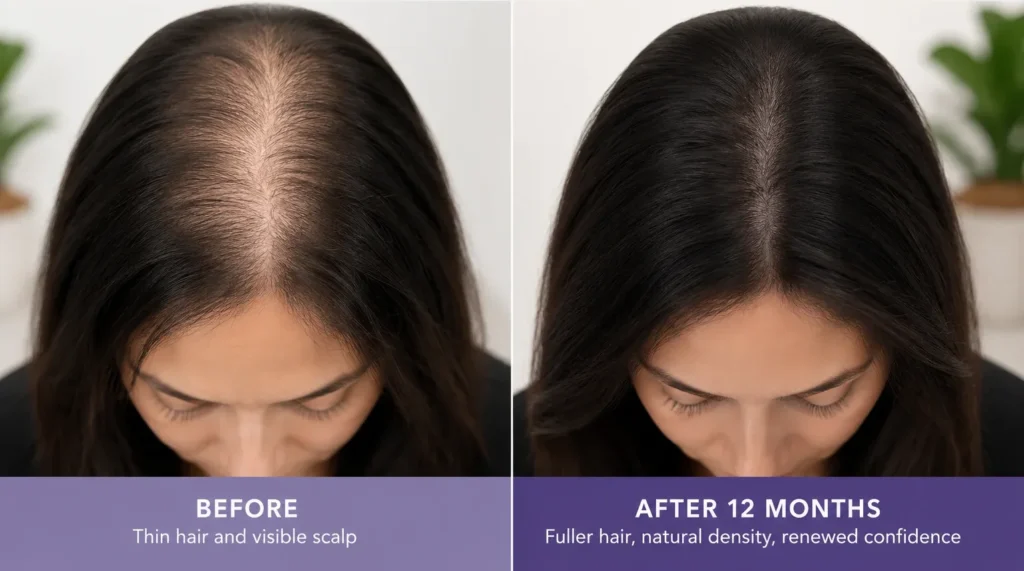
Recovery from women’s hair transplants follows a consistent, well-documented progression over approximately 12–18 months.
- Week 1: The scalp is tender, with mild redness and scabbing around grafts. Gentle washing using the cup-pouring method can begin around day 4; avoiding friction, pressure, and direct water streams is essential.
- Weeks 2–4: Scabs begin to loosen and shed naturally. Shock loss typically peaks during this window as transplanted follicles enter a resting phase before initiating new growth.
- Months 1–3: This is a temporary dormant phase. Transplanted hairs may continue to shed, and the scalp may appear similar to or slightly thinner than before surgery. There is minimal visible growth. This is the most psychologically challenging phase, but it is a normal part of the hair cycle.
- Months 3–4: Fine new hairs begin to emerge. Texture and thickness increase gradually over time.
- Months 6–9: Visible improvement becomes apparent. Density and coverage increase noticeably, and many patients begin to feel excited about their surgery.
- Months 9–12: Results continue to mature. Hair becomes thicker and more consistent in texture, looking and feeling more natural.
- Months 12–18: Final results are reached. Full density and the natural appearance of transplanted hair can be evaluated. Results vary by individual, age, hair characteristics, and technique used.
Understanding this timeline before surgery helps you stay confident and patient through the slower phases of recovery and avoid unnecessary concern.
How Much Does a Female Hair Transplant Cost?
The average cost of a female hair transplant in the United States is between $4,000 and $15,000+. The cost of the hair transplant procedure is primarily based on the number of hair grafts to be transplanted to meet your goals. Women with more extensive thinning require more grafts per session, increasing both procedure time and overall cost. A small hairline refinement requiring 500–800 grafts will cost considerably less than a comprehensive crown restoration requiring 2,000 grafts or more.
Other factors that influence the cost include the severity of hair loss, the size of the recipient area, the type of procedure, individual aesthetic goals, the plastic surgeon’s experience, and the practice’s geographic location. Philadelphia and the South Jersey area may have higher overhead due to the cost of living and operating costs in a major metropolitan area, which is reflected in procedure pricing.
Typical Philadelphia and the South Jersey area Hair Transplant Costs:
- Manual FUE: $7,500–$15,000
- ARTAS Robotic FUE Hair Transplant: $8,000 to $18,000+
- FUT: $6,000–$12,000
- PRP: $1,500–$3,500 for an initial course of 3–4 sessions, with maintenance sessions approximately $500–$1,000 each
A personalized consultation provides the most accurate treatment plan and pricing estimate.
Women’s hair restoration procedures are considered cosmetic and not covered under medical insurance. Procedure costs vary based on individual goals, and financing options are available at many practices to help make the process more accessible. For patients in Pennsylvania, New Jersey, and Delaware, pricing can also vary by market, which is another reason a personalized consultation is the most reliable way to receive an accurate estimate based on individual needs. A precise cost estimate is provided after consultation, once the plastic surgeon creates a personalized surgical plan.
Learn more about whether hair transplant surgery is worth it here.
Beyond the Scalp: Hair Restoration for Eyebrows, Hairlines, and More

Female hair restoration is not limited to the scalp. A growing number of women seek hair transplantation in other areas. According to a recent PR Newswire survey, the percentage of women seeking non-scalp hair restoration procedures increased to 21% in 2024, up from 17% in 2021.
- Eyebrow Transplants: Many women experience sparse or absent brows due to years of over-plucking, alopecia, thyroid-related hair loss, or genetics. Eyebrow transplantation uses fine scalp follicles to permanently restore natural-looking fullness, without the daily commitment of penciling or microblading.
- Hairline Refinement and Lowering: Women with naturally high hairlines or those whose hairlines have shifted after prior surgery can benefit from hairline restoration procedures. These involve carefully placing individual grafts along the frontal hairline to create a softer, more proportionate frame for the face.
- Hairline Feminization, Sideburns, and Beard Restoration for Transgender Women: Hair transplantation to lower the frontal hairline, enhance sideburns, and restore beard growth is increasingly sought by transgender women as part of gender-affirming, inclusive surgical care.
No matter the goal, the same principles of donor quality, follicle handling, and plastic surgeon expertise apply.
What to Avoid When Choosing a Hair Transplant Surgeon
Not every plastic surgeon has equal experience with female hair loss, and several avoidable mistakes can lead to poor outcomes.
- Choosing a plastic surgeon without female hair loss experience: Many specialize heavily in male pattern baldness and may underestimate the complexity of diffuse female thinning. Look for a plastic surgeon who routinely evaluates and treats female patients.
- Skipping the medical workup: Thyroid dysfunction, iron deficiency, and hormonal imbalances can all cause or worsen hair loss. Ruling these out before surgery may reduce the extent of intervention needed.
- Overestimating on graft count: More grafts do not automatically produce better results. An ethical plastic surgeon recommends only what is genuinely required.
- Ignoring the donor zone: In women with diffuse thinning, the donor area may itself be compromised. A thorough scalp analysis of the donor region is necessary before any surgical recommendation is made.
- Accepting unrealistic promises: No ethical plastic surgeon can guarantee a specific final density or cosmetic result. Outcomes depend on follicle survival, continued hair loss progression, and individual healing. Any consultation that promises guaranteed results warrants skepticism.
Schedule Your Hair Restoration Consultation in Philadelphia or South Jersey Today
Hair transplant is a well-established, personalized approach to female hair restoration, but achieving the best possible outcome depends on accurate diagnosis, careful candidate selection, and choosing a plastic surgeon with genuine expertise in female hair loss.
Women experiencing hair loss face unique challenges that require specialized evaluation, careful assessment of the donor area, and artistic treatment planning.
Female hair loss is distinct in its pattern and causes; candidacy is not universal; technique selection is individualized; and results develop gradually over 12–18 months. Understanding each of these factors before committing to surgery is what separates a confident, well-prepared patient from one who feels uncertain at every stage of the process.
Dr. Adrian Lo, M.D., FACS, FRCS(C) is a board-certified plastic surgeon with over 30 years of experience performing cosmetic procedures for patients across Pennsylvania, New Jersey, and Delaware.
Patients choose Dr. Adrian Lo because he offers:
- Board-certified plastic surgery expertise
- More than 30 years of surgical experience
- Personalized treatment plans
- Advanced ARTAS robotic technology
- Natural hairline design tailored to women
- Comprehensive surgical and non-surgical hair restoration options
- Convenient locations serving Philadelphia, South Jersey, Delaware, and the surrounding region
Dr. Lo has been recognized by Newsweek as one of America’s Best Plastic Surgeons in 2021, 2023, 2024, 2025, and 2026 and remains committed to delivering natural-looking, age-appropriate hair restoration results.
He performs hair restoration using the ARTAS robotic FUE system, one of the most advanced hair transplant technologies available, and personally designs every hairline to achieve a natural, age-appropriate result grown from the patient’s own permanent follicles.
If you have been considering a hair transplant, the best next step is a one-on-one evaluation in which your specific hair loss pattern, donor area, and restoration goals can be fully assessed.
Schedule a personalized consultation to discover whether hair transplantation is the right solution for your hair restoration goals.

Frequently Asked Questions About Female Hair Transplants
Are female hair transplants permanent?
Yes. Transplanted follicles are typically taken from genetically stable donor areas and continue growing after transplantation.
Does a female hair transplant look natural?
When performed by an experienced hair restoration surgeon, results can look virtually indistinguishable from natural hair growth.
What is the best age for a female hair transplant?
There is no ideal age. The most important factors are diagnosis, donor hair quality, and stabilization of hair loss.
Does hair transplant hurt?
Most patients report minimal discomfort because the procedure is performed under local anesthesia.
How long does it take to see results?
Visible growth usually begins around 3 to 4 months, with continued improvement through 12 to 18 months.