

Medically Reviewed By: Dr. Adrian Lo, M.D., FACS, FRCS(C)

FUE vs. FUT hair transplant TLDR: FUE is often preferred for patients who want shorter hairstyles, faster donor-area healing, and no linear scar. FUT may be better for patients who need the maximum number of grafts in a single procedure. According to a clinical review published via the National Library of Medicine’s StatPearls, FUE is currently the most commonly used technique. However, the best choice depends on donor hair supply, hair-loss severity, hairstyle preference, healing time, and long-term goals.
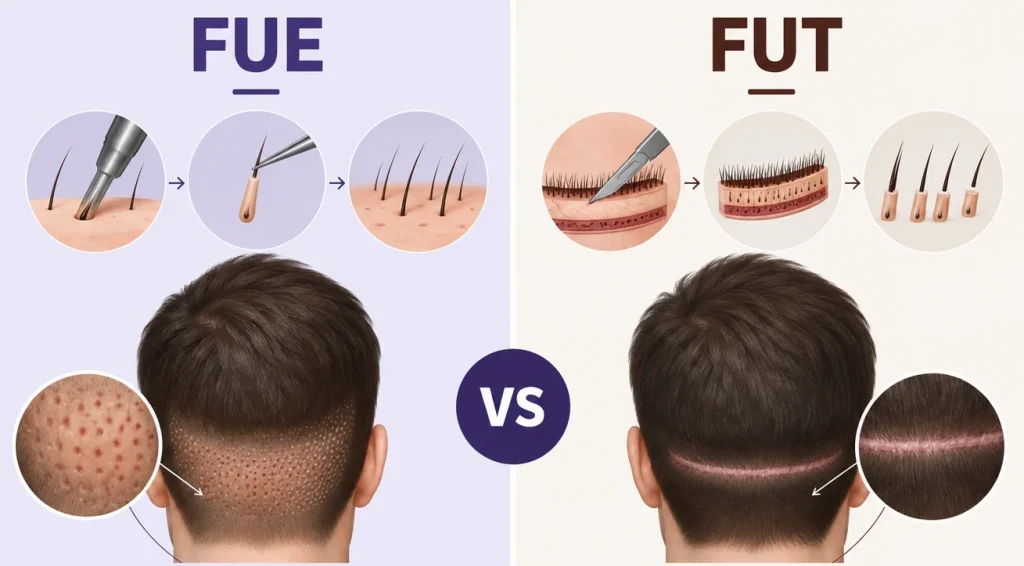
FUE (Follicular Unit Excision) and FUT (Follicular Unit Transplantation) are the two primary techniques used in modern hair restoration surgery. FUE removes individual follicular units one at a time, while FUT removes a single strip of donor tissue that is divided into follicular grafts under a microscope. Both can produce natural-looking, long-lasting results when an experienced hair restoration surgeon performs them.
For most hair transplant patients, FUE is preferred because it avoids a linear scar, supports shorter hairstyles, and typically heals faster in the donor area. FUT may better suit patients who need many grafts in a single session.
FUE vs. FUT Hair Transplant: Key Differences at a Glance
| Factor | FUE | FUT |
| Donor harvest method | Individual follicular units removed one at a time | Single strip of tissue removed, then dissected into follicular units |
| Donor-area incision | Small, dot-like incision marks spread across a larger area | One visible incision line or scar |
| Linear scar | No | Yes, generally hidden by surrounding hair |
| Donor-area healing time | Several days to about one week | Approximately 10 to 14 days |
| Graft yield per session | Effective for moderate sessions; larger sessions may need multiple visits | Can allow a higher graft yield in a single session |
| Hairstyle flexibility afterward | Well suited to very short hairstyles | Best suited to styles that keep the donor area covered |
| Best-suited candidates | Patients who want to wear hair short, have limited scalp laxity, or want to avoid a single incision line | Patients seeking maximum graft yield in one session who do not mind covering the donor area |
| Typical cost per graft | $5 to $10 per graft | $2 to $6 per graft |
What Is FUE (Follicular Unit Excision)?
Follicular Unit Excision (FUE) removes individual follicular units from the donor area, usually the back and sides of the scalp, using a small punch device. Because FUE removes no strip of tissue, it leaves small, dot-like marks rather than a linear scar, making it popular among patients who prefer shorter hairstyles.
FUE can be performed manually with a handheld punch device or with advanced robotic technology. At Philadelphia Plastic Surgery, Dr. Adrian Lo offers ARTAS Robotic FUE, which uses image-guided technology to support consistent graft harvesting and reduce follicle transection (accidental damage to the follicle) and extraction variability.
What Is FUT (Follicular Unit Transplantation)?
Follicular Unit Transplantation (FUT), often called strip surgery or harvesting, removes a thin strip of tissue from the back of the scalp, then divides it under a microscope into follicular grafts for transplantation. The procedure typically results in a single linear donor scar rather than multiple small FUE marks.
FUT often provides a higher graft yield in a single session, making it useful for patients with advanced hair loss.
Donor-Area Healing and Incision Marks
Scarring is an important consideration when choosing between FUE and FUT.
With FUT, the donor wound is closed in a single line, and the incision typically heals over 10 to 14 days. The resulting single linear scar is generally narrow and easily covered by surrounding hair, at least ~ ½ inch long.
With FUE, each donor site heals individually, and initial visible redness often resolves in about a week, though the small incision marks can take longer to fully fade. The small extraction sites are generally less noticeable, making FUE popular among patients who wear shorter hairstyles.
Neither FUE nor FUT is completely scar-free. The best choice depends on donor-hair characteristics, hairstyle preferences, and long-term goals.
Graft Quality, Yield, and Donor Supply
Both FUE and FUT can produce natural-looking, permanent results when an experienced hair restoration surgeon performs them, with surgeon skill and donor-hair management often having a greater impact on results than the harvesting method itself.
Both techniques transplant healthy follicular units, but they differ in how they harvest grafts.
- In FUT, stereo-microscopic dissection lets the surgical team isolate follicular units from the donor strip with surrounding protective tissue intact, which can support graft survival.
- In FUE, follicular units are extracted one at a time directly through the skin, and because the angle of each follicle below the skin’s surface cannot be seen directly, graft quality varies more with the plastic surgeon’s experience and the equipment used. Robotic FUE systems are designed to reduce this variability by using imaging to guide extraction.
FUT often provides a higher graft yield in a single procedure, while FUE may require harvesting from a broader donor area when you need more grafts.
FUT vs. FUE Transplant Recovery Timeline

Recovery differs mainly in the donor area because recipient-area healing, involving small scabs that shed within one to two weeks, is similar for both techniques.
- FUT: Most patients experience temporary mild tightness due to stitches or staples. Donor-area healing typically occurs within 10 to 14 days.
- FUE: Because there is no linear incision line, patients typically resume light activity sooner, often within a few days.
For both procedures, strenuous exercise is generally restricted for several weeks to protect newly transplanted grafts.
Every patient heals differently, and we discuss a personalized recovery timeline during your consultation.
Hair Transplant Cost: FUE vs. FUT
FUE typically costs more per graft than FUT because it harvests each follicular unit individually. Typical costs are approximately $5 to $10 per graft for FUE and $2 to $6 per graft for FUT. According to the American Society of Plastic Surgeons (ASPS) and the International Society of Hair Restoration Surgery (ISHRS), total cost depends mainly on graft count, technique, and the treating plastic surgeon’s experience, which is why most U.S. sessions range from about $6,000 to $15,000+.
Financing can offer affordable options and help patients move forward, since earlier treatment can address hair loss concerns before they advance.
Am I a Better Candidate for FUE or FUT?
Ideal FUE Candidates
- Patients who wear short hairstyles
- Patients seeking minimal visible donor scarring
- Patients with limited scalp laxity
- Patients interested in robotic hair restoration
Ideal FUT Candidates
- Patients requiring high graft counts
- Patients experiencing advanced hair loss
- Patients comfortable with a concealed linear scar
Learn more about who is not a good candidate for hair transplantation.
ARTAS Robotic Hair Restoration With Dr. Adrian Lo

Why Patients Choose Dr. Adrian Lo for Hair Restoration
Choosing between FUE and FUT matters, but choosing an experienced hair restoration surgeon matters just as much. Natural-looking density, donor-hair preservation, graft survival, and long-term planning all depend heavily on surgical expertise.
Dr. Adrian Lo is double board-certified with the American Board of Plastic Surgery and the Royal College of Physicians and Surgeons of Canada. With more than 30 years of experience, Dr. Adrian Lo evaluates every hair restoration patient individually to determine whether FUE, FUT, or a combined approach will produce the best long-term outcome.
Patients choose Dr. Lo for:
- More than 30 years of surgical experience
- Personalized treatment planning
- Natural-looking hairline design
- ARTAS® robotic FUE technology
ARTAS® Robotic FUE provides a technology-assisted approach supporting precise graft harvesting, donor-hair preservation, and consistent extraction patterns. Benefits may include:
- Image-guided graft harvesting, reducing follicle transection and resulting in enhanced graft consistency compared with manual FUE
- No linear incision line
- Consistent, algorithm-assisted harvesting depth and angle
- Natural-looking graft placement
Find Out Whether FUE or FUT is Right for You
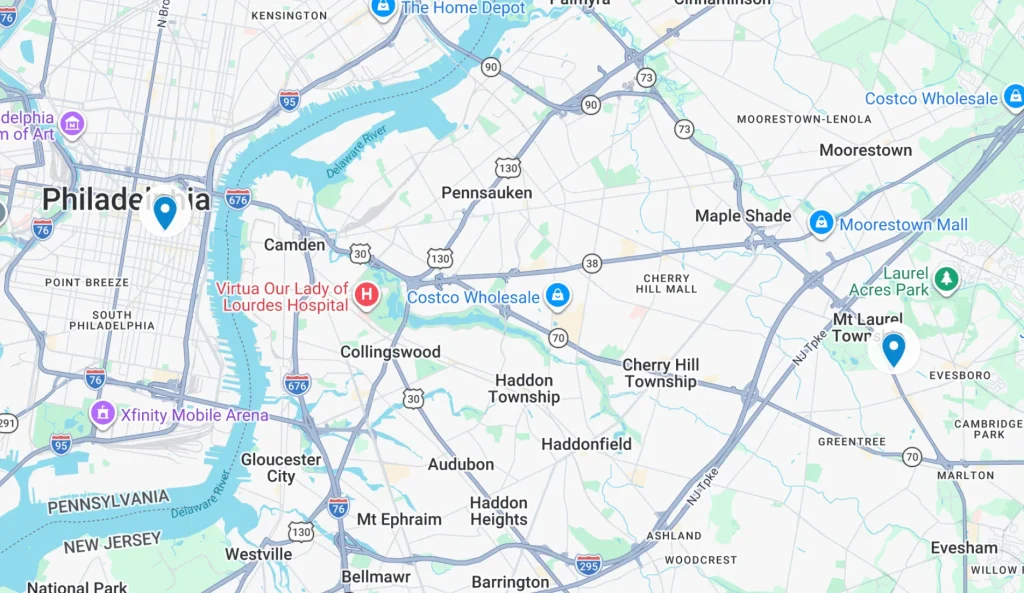
Patients considering hair restoration in Philadelphia, Marlton, Cherry Hill, the Main Line, and surrounding communities often choose between FUE and FUT based on their donor hair supply, hairstyle goals, and long-term treatment plan.
Every hair loss pattern is different. During your consultation, Dr. Lo will evaluate your donor hair, scalp characteristics, hair-loss pattern, and goals to determine whether FUE, FUT, or a combined approach is right for you.
FAQs
Is FUE Or FUT Better For Hair Transplant Surgery?
Neither is universally better. FUT often yields more grafts per session, while FUE avoids a single incision line and suits shorter hairstyles. A plastic surgeon can recommend the best option for you.
How Long Does It Take To Recover From FUE Compared With FUT?
FUE donor-area healing is often quicker in the first week, while FUT incisions typically heal within 10 to 14 days. Recipient-area healing is similar for both.
Can FUE and FUT Be Combined?
Yes. Some patients start with FUT to maximize yield, then use FUE later when the scalp is too tight for another strip procedure.
Which Hair Transplant Looks More Natural, FUE or FUT?
When performed properly, both FUE and FUT can produce natural-looking results. Hairline design, graft placement, and surgeon experience typically affect appearance more than the harvesting method itself.
Which Hair Transplant Method Has The Highest Graft Yield?
FUT typically produces the highest graft yield in a single procedure because it harvests hair from a concentrated donor strip. Patients requiring extensive restoration may therefore be stronger candidates for FUT or a combination of FUT and FUE.
Is ARTAS Better Than Manual FUE?
ARTAS is an advanced robotic FUE system that uses imaging and algorithm-guided harvesting to support consistent graft extraction with a reduced transection rate. Whether ARTAS or manual FUE is best depends on patient anatomy, donor characteristics, and surgeon experience.
Which Hair Transplant Leaves Less Visible Scarring?
FUE generally leaves less visible scarring because it creates many small dot-like extraction sites rather than a single linear donor scar. However, neither technique is completely scar-free.