

Medically Reviewed By: Dr. Adrian Lo, M.D., FACS, FRCS(C)
TL; DR.
Do hair transplants work on the crown? Yes, hair transplants work on the crown, but it’s the hardest part of the scalp to restore and the slowest to show results. Transplanted follicles come from the back and sides of the scalp, where hair resists the hormone that drives pattern hair loss, so they keep growing after they are moved. New growth usually appears 3 to 6 months after surgery, and the crown is often evaluated at 12 to 18 months. Patients in Philadelphia, South Jersey, and Delaware considering crown restoration should plan around that timeline and expect to protect the surrounding native hair with medication.
Key Takeaways
- Transplanted crown hair is permanent because donor follicles retain their resistance to DHT after being moved.
- The crown’s spiral growth pattern and large surface area make it harder to restore than the hairline.
- Native hair around the transplant can keep thinning, so many patients pair surgery with medication such as finasteride or minoxidil.
- New growth usually starts at 3 to 6 months, and crown results are commonly judged at 12 to 18 months.
- Donor hair is limited, and the crown competes with the hairline for it, so planning matters as much as technique.
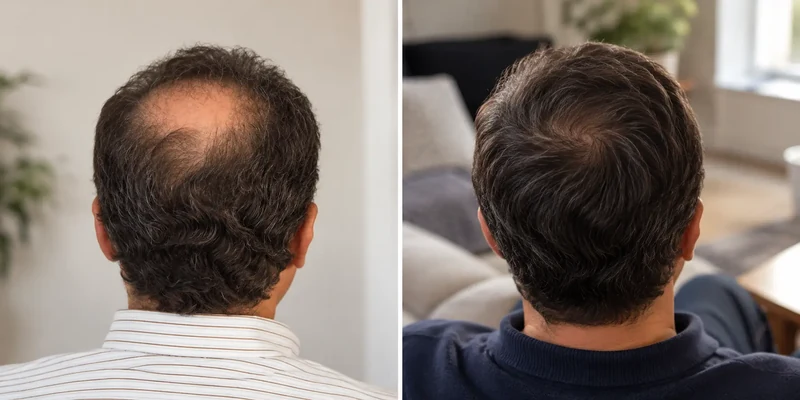
The crown, also called the vertex, is the area at the top and back of the scalp where hair grows in a spiral fashion. Crown baldness is one of the most challenging areas to restore because it often affects a large surface area and requires more grafts than many patients expect. Fortunately, modern FUE hair transplantation can successfully restore crown density when adequate donor hair is available and hair loss is stable.
Results depend on how many grafts your donor area can supply, whether your hair loss has slowed, and how well each graft is angled to match your natural spiral. This guide explains what the evidence shows, who is a good candidate, how many grafts may be needed, and what to expect during recovery.
Do Hair Transplants Work on the Crown?
Yes. Hair transplants can successfully restore thinning or bald areas of the crown. Transplanted follicles come from DHT-resistant donor areas on the back and sides of the scalp and continue growing after relocation. The crown is often the most difficult part of the scalp to restore because of its spiral growth pattern, larger surface area, and ongoing risk of surrounding native hair loss. Most patients begin seeing growth at 3 to 6 months and achieve final crown results between 12 and 18 months.
According to the StatPearls clinical reference on hair transplantation, published through the National Library of Medicine, hair transplantation is the standard surgical treatment for pattern hair loss and has replaced older methods such as plug grafts and scalp reductions. The procedure moves follicular units from the back and side of the scalp, where hair is resistant to androgens, into thinning areas.
That resistance is what makes the result permanent. Transplanted follicles keep their genetic programming after they are moved, so pattern hair loss does not cause them to fall out the way the original crown hair did.
In the ISHRS 2025 Practice Census, FUE harvesting was used in 85.4% of male hair restoration procedures and 67.3% of patients achieved their desired result with one procedure, with an average of 1.5 procedures per patient.
The limit is the native hair. The biggest limitation in crown restoration is the ongoing loss of native hair surrounding the transplant. While transplanted follicles are generally permanent, untreated native hair can continue thinning. Many patients combine surgery with finasteride, minoxidil, or both to preserve existing hair and maintain long-term density. According to StatPearls, 72.3% of census respondents said they always or often prescribe finasteride 1 mg. Finasteride is FDA-approved for men only and has possible side effects, so it is a decision to make with your plastic surgeon.
Why the Crown Is Harder to Restore Than the Hairline
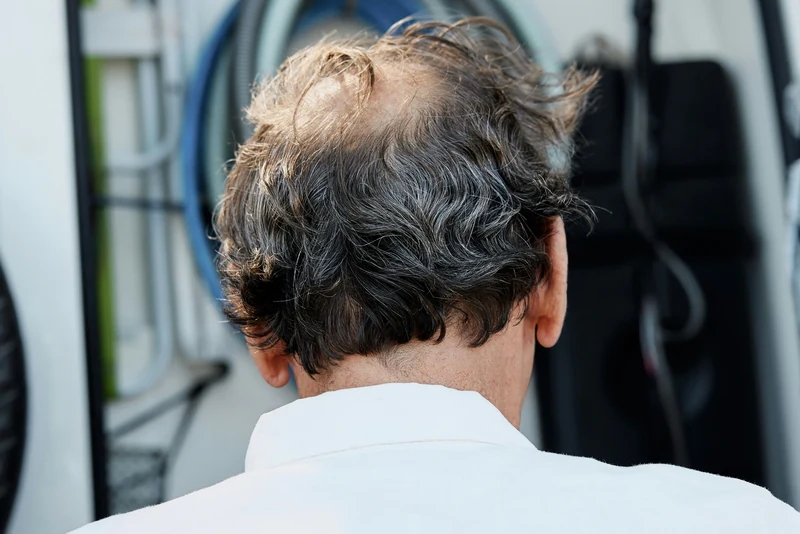
Hair at the front of the scalp grows in roughly one forward direction. Crown hair radiates outward from a central point called the whorl, clockwise in some men and counterclockwise in others. To achieve a natural appearance, grafts must be placed at the angle to match that spiral pattern and natural growth direction.
The spiral also changes how full the crown looks. Crown hairs point away from each other instead of lying in overlapping rows, so more scalp shows between them, especially under overhead light. A graft density that looks full at the hairline can look thinner at the crown.
Size is the third factor. The crown is a large area that may continue widening over time. Continued hair loss around the crown can leave transplanted hair as an island of density surrounded by thinner native hair. Good crown planning accounts for future hair loss progression.
Why the Crown Can Look Thinner After a Transplant
It is common for the crown to look worse for a few months before it looks better. Three things cause this in the short term:
- Graft shedding: Transplanted hair shafts usually fall out within the first few weeks. The follicles stay in place under the skin and grow new hair later.
- Shock loss: Native hair around the grafts can also shed in response to surgery. This is temporary, with new hairs typically appearing after 3 to 6 months.
- The spiral effect: Even when growth is complete, the crown’s outward-pointing pattern lets more scalp show than at the hairline.
Progressive hair loss can make results appear patchy years later, even after a technically successful procedure. Medication can help slow progression.
How Many Grafts Does a Crown Transplant Need?

The number depends on the size of the thinning area, how dense your donor hair is, and how thick each hair is. As a reference point, ISHRS members reported an average of 2,347 grafts for a first procedure in the 2025 census, across all treatment areas. A small crown may need fewer than that. An extensive crown may need more grafts than one session can safely supply.
Dr. Lo’s typical crown graft ranges from 500 for mild to 2000 for extensive crown thinning.
Donor hair is limited and the crown competes with the hairline for the same supply. If too many grafts go to the crown early, there may not be enough left to restore the front hairline if it recedes later. For this reason, many treatment plans restore the hairline first and treat the crown once hair loss has stabilized.
Who Is a Good Candidate for a Crown Hair Transplant?
Ideal crown hair transplant candidates have stable hair loss, sufficient donor hair, realistic expectations and are open to medical therapy when appropriate.
For crown hair transplantation, these are the most important factors influencing outcomes:
- Stable hair loss: If the crown is still widening quickly, transplanted hair may end up isolated. A stable pattern makes the result more predictable.
- Donor density: A dense donor area at the back and sides supplies enough grafts for the crown and for future needs.
- Age: Younger men have the least predictable hair loss. In the ISHRS census, 73% of members reported a minimum age for surgery, with an average cutoff of 22.
- On medication therapy, when appropriate: Men who already take finasteride or minoxidil and have kept their hair steady are often the strongest candidates.
- Realistic expectations: The goal is natural-looking improvement, while preserving donor hair for future needs, not full restoration of youthful density.
Some men are not candidates at all. If thinning affects the back and sides of the scalp, a pattern sometimes called diffuse unpatterned alopecia (DUPA), the donor follicles may not remain permanent after transplantation.
FUE vs. FUT for the Crown
Both FUE and FUT harvesting methods can restore the crown. The difference is how grafts are taken from the donor area.
FUE (follicular unit excision) removes follicular units one at a time with a small punch, leaving tiny round marks spread across the donor area. It is by far the most common method in the 2025 census.
FUT (follicular unit transplantation, or strip harvesting) removes a thin strip of scalp from the back of the head, then divides it into individual grafts. It leaves a single linear surgical incision line, which surrounding hair usually hides. ISHRS notes that FUE may cost more than FUT because it is more labor-intensive for the physician.
For the crown, graft placement matters more than the harvesting method. Each graft has to follow the direction and angle of the whorl. Dr. Lo uses robotic systems like ARTAS to assist with extraction.
Successful crown restoration depends on precise graft placement. Dr. Adrian Lo uses the advanced ARTAS robotic system to help maximize graft quality while preserving the donor hair.
Crown Transplant Timeline: Month by Month
- First 2 weeks: Small crusts form around the grafts, and the scalp may be red or itchy. Grafts are most fragile in the first days. Follow your post-op instructions closely.
- Weeks 2 to 8: Transplanted hair shafts shed, and some native hair may shed too. The crown may look thinner than it did before surgery.
- Months 3 to 6: New hairs begin to appear and are often fine at first.
- Months 6 to 12: Hair thickens and darkens. StatPearls recommends follow-up with photos around 6 to 12 months as the grafts mature.
- Months 12 to 18: The crown continues filling in. Crown growth lags behind the front, and final results are often assessed during this period.
Talk to Dr. Lo About Restoring Your Crown
Whether hair transplants work on the crown depends on your donor area and how stable your hair loss is. Dr. Adrian Lo is a board-certified plastic surgeon who has been in practice since 1991. At your consultation, he will examine your crown and donor area, review how your hair loss has progressed, and explain whether a crown transplant, medication, or a staged plan makes sense for you.
Patients travel from Philadelphia, South Jersey, Delaware, the Main Line, Cherry Hill, Princeton, and surrounding communities for hair restoration with Dr. Lo.
To find out how many grafts your crown may need, schedule a consultation with Dr. Lo.

Frequently Asked Questions
Are Crown Hair Transplants Permanent?
The transplanted follicles are permanent because they come from DHT-resistant donor areas. The native hair around them has no such protection, which is why medication matters after surgery.
How Much Do 3,000 Hair Grafts Cost?
The price depends on the per-graft fee, the harvesting method, and the number of sessions you need. An ARTAS robotic hair transplant costs $7,000 to $18,000+, averaging $7 to $8 per graft.
You will receive a personalized quote and financing information during your consultation with Dr. Lo.
Can a Person Wear a Cap After a Hair Transplant?
Yes, with care. During early healing, avoid hats that put pressure or friction on the grafts. Dr. Lo will advise when different types of headwear are safe for your grafts.
What Age Should I Get a Crown Transplant?
There is no single right age. A stable pattern and a healthy donor area matter more than the number. Younger men often start with medication and revisit surgery once their pattern is clearer.
Should I Treat My Hairline or My Crown First?
Many treatment plans restore the hairline first because it frames the face. The crown is treated later once hair loss has stabilized and the remaining donor supply is clear. The right order depends on your pattern and your goals.
What Is the Success Rate of a Crown Hair Transplant?
A successful crown hair transplant depends on graft survival, donor quality, surgical technique, and future hair-loss progression. Modern FUE procedures typically achieve high graft survival rates, but perceived success ultimately depends on achieving enough density to reduce scalp visibility while preserving donor hair for future needs.
Is the Crown Harder to Transplant Than the Hairline?
Yes. The crown is generally considered the most difficult area of the scalp to restore because hair grows in a circular whorl pattern, covers a larger surface area, and often requires more grafts to achieve visible density improvements.