

Medically Reviewed By: Dr. Adrian Lo, M.D., FACS, FRCS(C)
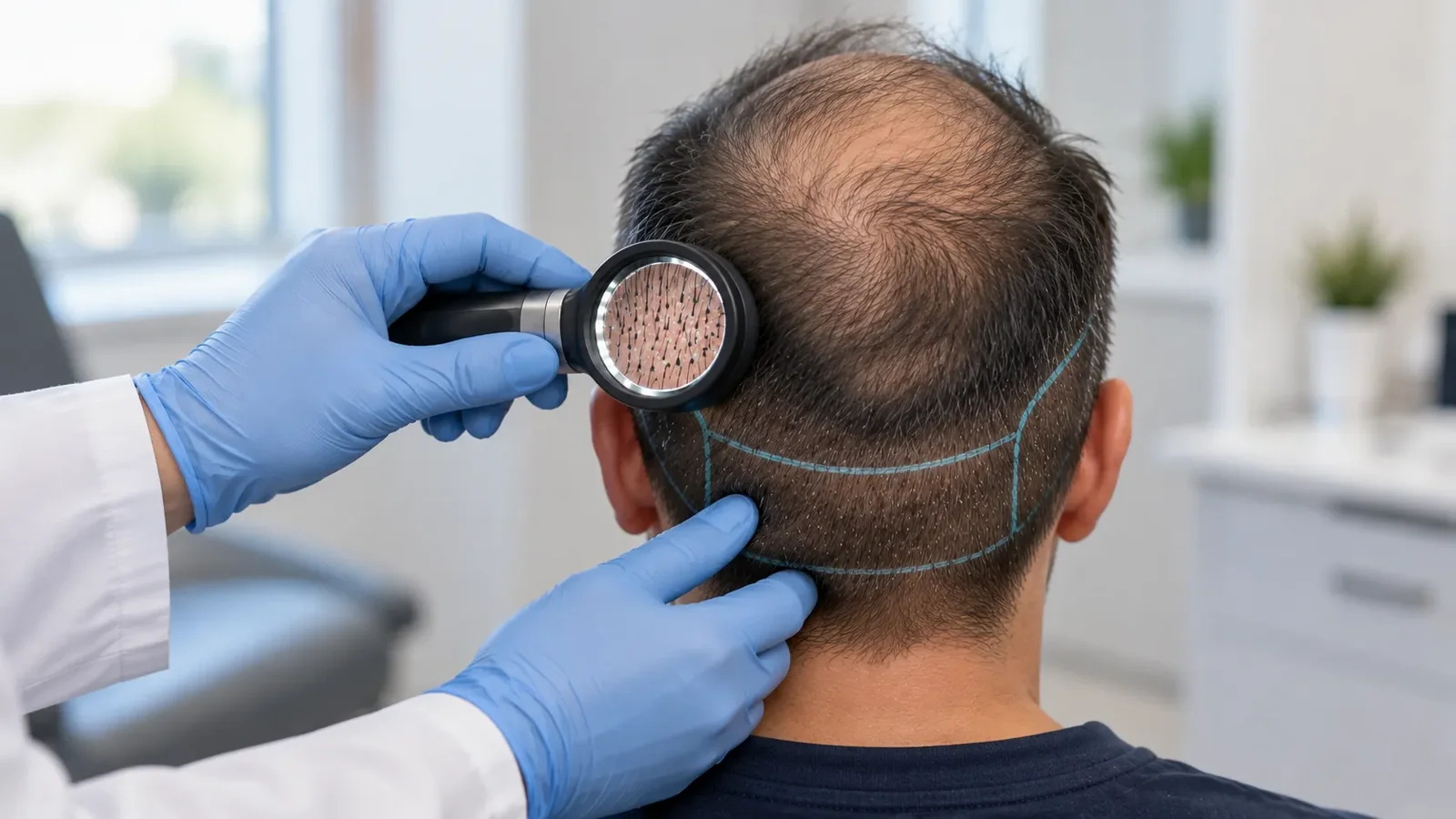
Wondering how many grafts do I need for a hair transplant? Most people need 1,000 to 4,000 grafts, but the exact number depends on hair loss, donor availability, hair characteristics, and desired density. According to the International Society of Hair Restoration Surgery (ISHRS) 2025 Practice Census, the average first hair transplant procedure uses about 2,350 grafts.
The number of grafts you need depends on your stage of hair loss, donor availability, hair characteristics, and desired fullness. The main caveat is that donor hair is limited.
Most patients need:
- 500-1,000 grafts for minor temple recession
- 1,000-2,000 grafts for a receding hairline
- 2,000-3,500 grafts for frontal and crown thinning
- 3,500-5,000 grafts for advanced hair loss
- 5,000-7,000+ grafts for extensive baldness, often over multiple sessions
At Dr. Adrian Lo’s Philadelphia and Marlton, New Jersey, practice, a typical hair transplant involves 800 to 2,500+ grafts, depending on the extent of hair loss. This guide explains how graft requirements are calculated and what factors determine your personalized graft estimate.
Key Takeaways
- The average first hair transplant uses about 2,350 grafts, and most cases fall between 1,000 and 4,000.
- One graft is not one hair. Each graft holds 1 to 4 hairs, or about 2 hairs on average.
- Graft needs increase with your Norwood stage, from about 500 grafts for mild recession to 7,000 or more for the most advanced loss.
- The scalp can safely give about 6,000 grafts over a lifetime by one standard estimate, so very large plans need several sessions and sometimes body hair.
- Only a hands-on exam of your donor area can confirm your number.
What Is a Hair Graft, and Is One Graft Equal to One Hair?
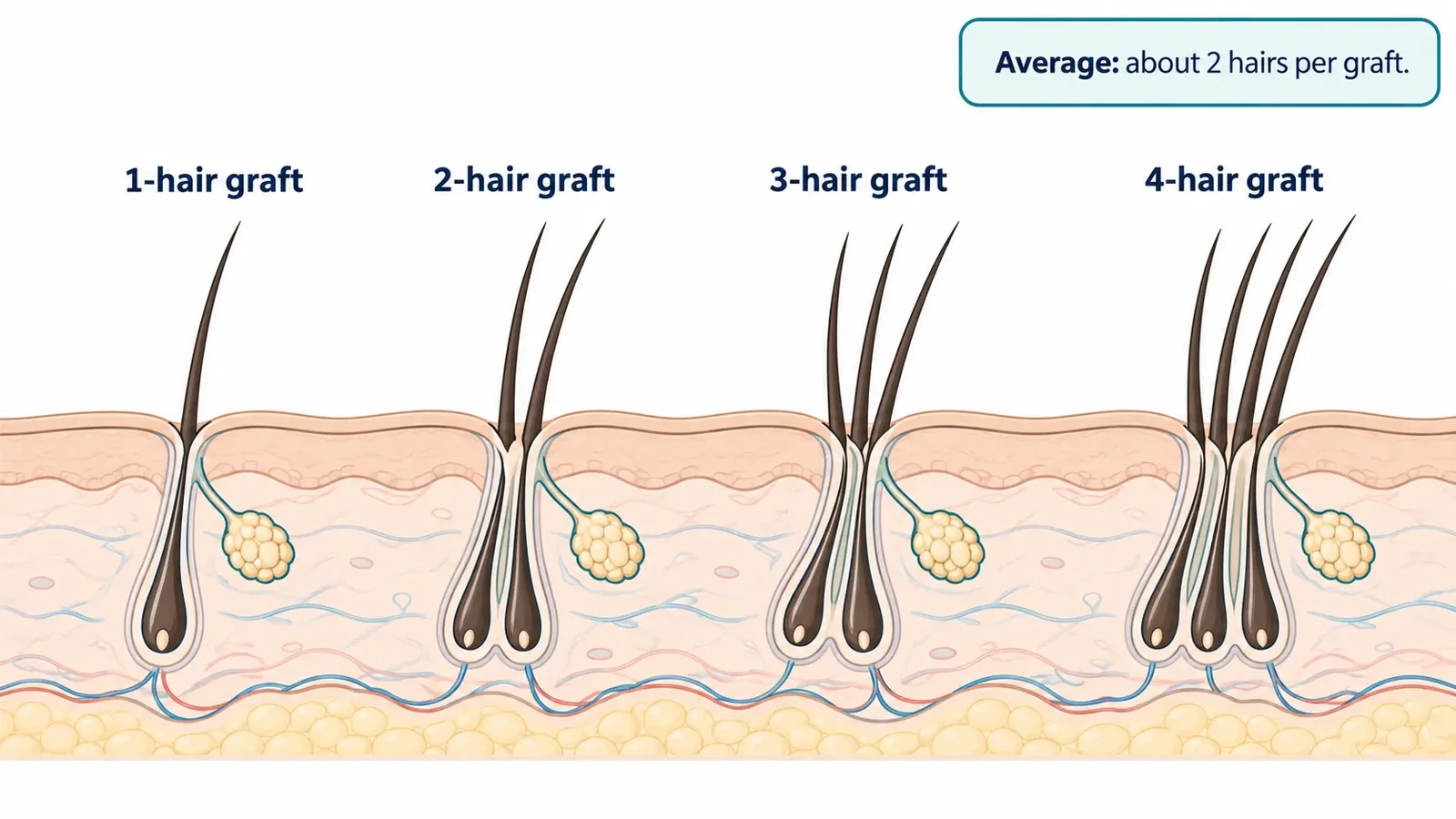
A hair graft is a follicular unit: a natural cluster of 1 to 4 hairs that grow together, along with a small oil gland and muscle, as described in the StatPearls clinical review hosted by the National Institutes of Health. So one graft is not one hair. Because each graft contains multiple hairs, patients often underestimate how much coverage they will get.
How many hairs are in a graft? A study in Dermatologic Surgery measured 65 to 85 follicular units, with 124 to 200 hairs per square centimeter, at the back of the scalp, which averages about 2 hairs per graft. In practical terms, 2,000 grafts often contain roughly 4,000 hairs.
Grafts are collected in one of two ways:
- Follicular unit extraction (FUE) removes grafts one at a time with a tiny punch, leaving small dot-like marks spread across the donor area. A robotic hair transplant uses image-guided technology for this step.
- Follicular unit transplantation (FUT) removes a thin strip of scalp, which a plastic surgeon divides into grafts under a microscope. It leaves a single linear incision line, which may show with very short hairstyles.
Both FUE and FUT relocate permanent follicles from the back and sides of the scalp to thinning areas. A transplant does not create new hair.
How Many Grafts Do I Need for a Hair Transplant? Graft Estimates by Norwood Stage

Plastic surgeons classify male pattern hair loss with the Norwood scale, which runs from stage I (little or no recession) to stage VII (only a horseshoe of hair left at the sides and back). StatPearls lists Norwood stages III to V as standard indications for a hair transplant.
For most men, Norwood stage is the strongest predictor of graft requirements. Your stage provides a starting range, not a final estimate.
| Norwood Stage | What the Hair Loss Looks Like | Typical Total Grafts |
|---|---|---|
| II | Slight recession at the temples | 500 to 1,000 |
| III | Deeper temple recession, sometimes early crown thinning | 1,000 to 2,000 |
| IV | Frontal loss plus a bald spot at the crown | 2,000 to 3,000 |
| V | Frontal and crown loss with a thin band of hair between them | 3,000 to 5,000 |
| VI | The band between the front and crown is gone | 5,000 to 7,000, over more than one session |
| VII | Only a horseshoe of hair remains at the sides and back | 7,000 or more, over several sessions, often with body hair |
Ranges for stages IV through VII reflect planning figures published in a peer-reviewed study in the Journal of Cutaneous and Aesthetic Surgery. Ranges for stages II and III reflect commonly used planning estimates. Your plastic surgeon’s exam sets your actual number.
Large graft totals often require multiple sessions. The ISHRS census found patients averaged 1.5 procedures to reach their goals. Typical procedures average 2,100 grafts for FUT and 2,260 grafts for FUE, while follow-up sessions average 1,640 grafts. StatPearls notes that FUE experts recommend limiting harvesting to 10-15 grafts per square centimeter per pass over the donor area.
While online graft charts provide useful planning estimates, the actual number can vary significantly based on donor density and hair characteristics. Only an experienced hair restoration surgeon can determine how many grafts can be safely transplanted while preserving future treatment options.
What About Women?
Female pattern hair loss is typically assessed using the Ludwig scale. Because thinning is often diffuse, women require personalized graft planning. According to the ISHRS census, women account for 15.3% of surgical hair restoration patients.
Grafts Needed by Area: Hairline, Crown, and Full Scalp
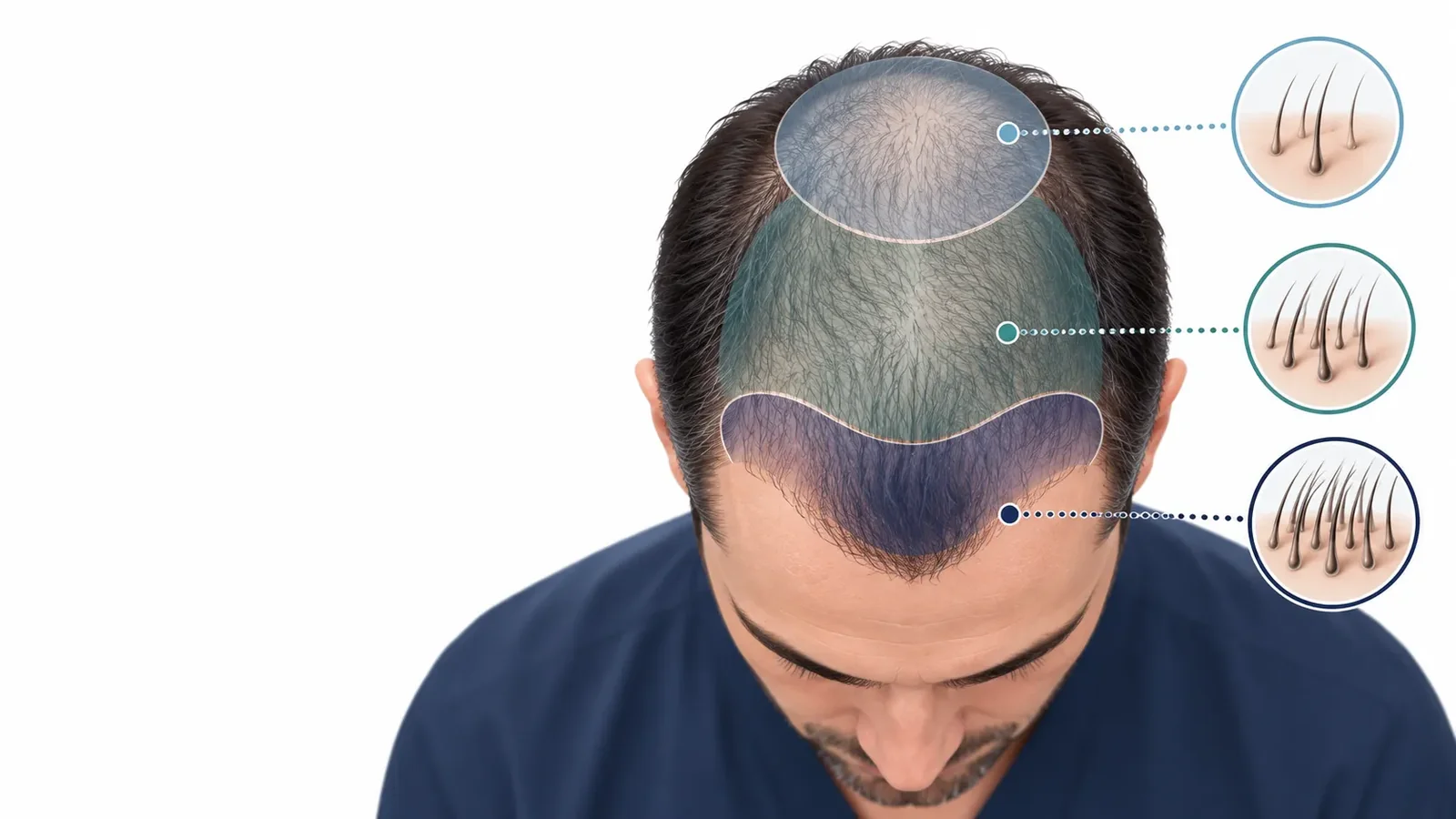
Plastic surgeons estimate grafts with a simple formula: area (square centimeters) multiplied by the planned density (grafts per square centimeter). StatPearls cites a target of about 30 grafts per square centimeter. If you are wondering what that is in grafts per square inch, it is roughly 190 to 260 grafts per square inch at 30 to 40 grafts per square centimeter. For example, a 50-square-centimeter area at 30 grafts per square centimeter needs about 1,500 grafts.
- Hairline and temples: The hairline receives careful planning because it strongly influences facial appearance. Clinicians place single-hair grafts at the front edge, with larger grafts behind them for fullness. StatPearls notes that treating frontal baldness often yields the most noticeable results and recommends a conservative, natural hairline.
- Mid-scalp: The midscalp area behind the hairline provides much of the visible density seen from above.
- Crown: The crown grows in a swirl and shows thinning from above. Surgeons often treat this area conservatively and prioritize the frontal scalp. Treating only the crown can leave isolated transplanted hair as surrounding hair loss progresses.
- Full top of the scalp: A peer-reviewed study estimates the balding area at about 300 square centimeters. Restoring it all at typical graft density would take around 9,000 grafts, more than most scalps can supply.
The 5 Factors That Set Your Graft Number
Even patients at the same Norwood stage may require very different graft counts because of these five factors.
- Donor density. The safe donor zone at the back of the scalp typically holds 65 to 85 follicular units per square centimeter. StatPearls describes donor areas above 80 units per square centimeter as excellent and those below 40 as less suitable.
- Hair thickness. Thicker hair shafts fill more of the scalp surface, so each graft looks fuller. Patients with fine hair may need more grafts for the same look.
- Hair and skin contrast. Light hair on light skin shows less scalp, so that it can look full with fewer grafts. Dark hair on light skin shows thinning more easily and calls for more careful density planning.
- Age and future hair loss. Hair loss in younger men often continues to progress. StatPearls recommends deferring surgery in young patients, starting medication for at least a year, and ideally waiting until after age 25. Saving grafts for later protects your options.
- Your goals. A transplant creates the appearance of density rather than restoring your original hair volume. A conservative, natural plan uses fewer grafts than a plan aimed at maximum fullness.
A hands-on exam measures each of these factors. That is why online graft calculators can only give ranges, not answers.
3,000 vs. 4,000 vs. 6,000 vs. 7,000 Grafts: What the Numbers Mean
When patients research how many grafts they need, these four numbers come up often. Here is what each one means, based on published data.
How Much Area Will 3,000 Grafts Fill?
At 30 to 40 grafts per square centimeter, 3,000 grafts can restore about 75 to 100 square centimeters, more than the average 2,350 grafts for a first procedure. That is roughly a quarter to a third of the 300-square-centimeter area that can go bald.
Is 4,000 Grafts Overharvesting?
Not necessarily. Overharvesting means taking so many grafts that the donor area looks thin or patchy. Whether 4,000 grafts constitute overharvesting depends on donor density, age, and how hair loss progresses in the future.
Research suggests the scalp’s safe donor zone is about 12,500 grafts, with about 6,000 considered harvestable over a lifetime. Using 4,000 grafts is two-thirds of that supply. It can be safe for a dense donor area. It can be risky for a thin donor area or for a young patient whose hair loss is still progressing.
Is 6,000 Grafts a Lot for a Hair Transplant?
Yes. A 6,000-graft plan is considered large; it is more than 2.5 times the average first procedure and approaches the estimated lifetime safe scalp donor supply. Advanced cases of 6,000+ grafts require multiple sessions and supplemental beard or body hair.
Is 7,000 Grafts Too Much?
For many patients, 7,000 grafts exceeds what the scalp alone can safely provide and may require multiple sessions or body hair, which can have a different texture.

Do All Transplanted Hair Grafts Grow?
No, and a good plan accounts for that. Graft survival depends on technique, how grafts are handled, and healing. In a 2024 BMC Surgery study of 158 men treated with FUE, more than 90% of transplanted follicles survived at 12 months. StatPearls notes that FUT may cause less damage to follicles because surgeons separate grafts under a microscope, while FUE avoids a linear incision line.
StatPearls lists smoking, diabetes with blood vessel damage, high blood pressure, heavy alcohol use, and advanced sun damage to the scalp as conditions that complicate hair transplantation. Following your hair transplant post-operative care instructions also protects new grafts.
Results also take time. Transplanted hairs typically shed in the first few weeks, which is expected; this is called shock loss. StatPearls reports that new hairs typically appear after 3 to 6 months and that grafts mature over 6 to 12 months. At Dr. Lo’s practice, patients typically see growth begin around 3 months, with final results around 9 to 12 months. Individual results may vary.
What Your Graft Count Means for Cost
Graft count is typically the biggest factor affecting hair transplant cost because larger procedures require more harvesting, graft preparation, and implantation time. The lowest graft estimate is not always the best value. A carefully planned procedure that preserves donor hair and creates natural density often delivers better long-term results than simply maximizing graft numbers.
At Dr. Lo’s practice, ARTAS® robotic hair transplant procedures range from about $8,000 to $18,000+, depending on complexity and graft count. Recipient size, number of sessions, and treatment goals also affect cost. Your exact quote follows a personalized surgical plan, and hair transplant financing options are available.
Planning Your Graft Count with Dr. Lo
Dr. Adrian Lo is a board-certified plastic surgeon with more than 30 years of experience, certified by the American Board of Plastic Surgery and the Royal College of Physicians and Surgeons of Canada. He is an attending physician at Pennsylvania Hospital, and patients travel from Cherry Hill, Main Line communities, South Jersey, Bucks County, Montgomery County, Delaware County, and northern Delaware to Dr. Lo’s offices in Philadelphia and Marlton, NJ, for personalized hair restoration evaluations.
During your consultation, Dr. Lo evaluates donor density and hair characteristics, maps your hairline and recipient areas, and creates a plan that protects donor supply. The procedure is performed under local anesthesia and typically takes 4 to 8 hours, depending on the number of grafts. If a transplant is not the right fit, he will explain why. You can also read about who is not a good candidate for a hair transplant.
Online charts provide useful estimates, but only a consultation can determine how many grafts you can safely transplant while preserving long-term donor reserves.
Schedule a consultation to receive your personalized graft estimate today.

Frequently Asked Questions
How Many Grafts Do I Need For a Receding Hairline?
Most patients with a receding hairline need 1,000 to 2,500 grafts, depending on temple recession, hairline design, and desired density.
Is 2,000 Grafts Enough For a Hair Transplant?
For many patients, 2,000 grafts can effectively restore a receding hairline or moderate thinning. Advanced hair loss may require additional grafts.
What is the Maximum Number of Grafts that Can Be Transplanted in One Session?
Most patients can safely undergo approximately 2,000-3,000 grafts in a single session, though total lifetime graft availability depends on donor density and scalp characteristics.