

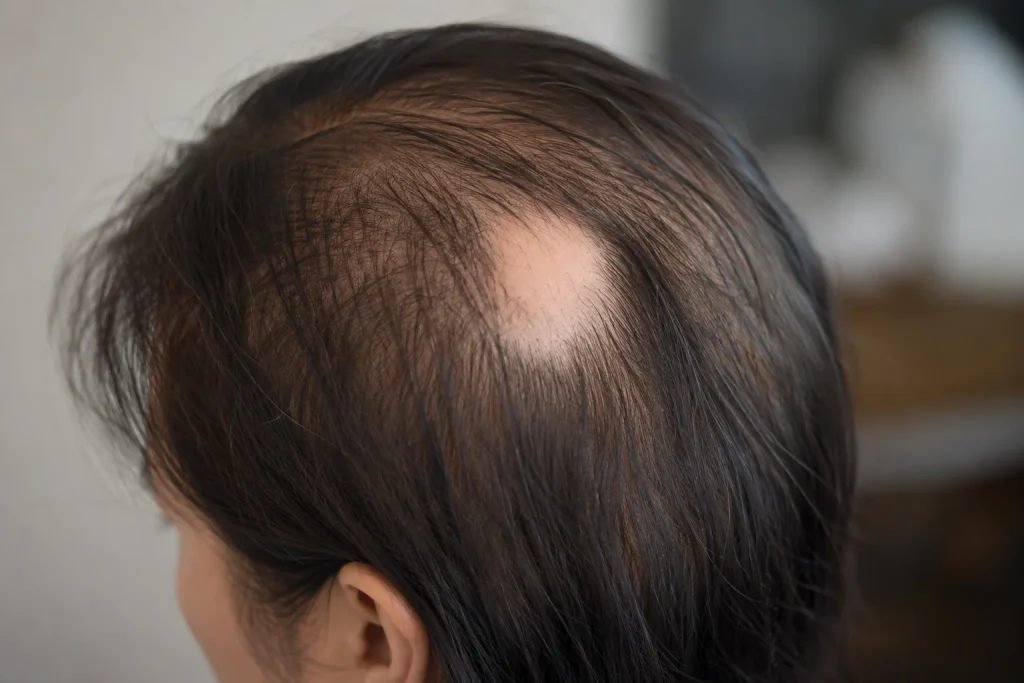
Can people with alopecia get hair transplants is a common question we receive, and the answer is yes, but eligibility depends entirely on the type of alopecia, the stability of the condition and the health of the donor hair. While patients with androgenetic alopecia (male or female pattern hair loss) are typically good candidates, individuals with alopecia areata, cicatricial (scarring) alopecia or traction alopecia may qualify only under specific circumstances. Others, such as those with Diffuse Unpatterned Alopecia (DUPA), where miniaturization spreads across the entire scalp, are typically not candidates for hair transplant surgery.
As a board-certified plastic surgeon specializing in advanced hair restoration, Dr. Adrian Lo performs comprehensive evaluations to determine whether a patient will benefit from modern techniques such as FUE (Follicular Unit Extraction) and FUT (Follicular Unit Transplantation). The key question is not simply whether you have alopecia, but whether your hair loss pattern can support long-term hair transplant success.
If you’re searching for answers about hair transplants for alopecia, this guide, medically reviewed by Dr. Adrian Lo, MD, a board-certified plastic surgeon, explains which forms of alopecia respond best to treatment, who qualifies for hair restoration for alopecia and why, and identifies circumstances in which surgery is not recommended and when non-surgical therapies may be the better option.
What Is Alopecia and Can People With Alopecia Get Hair Transplants?
Alopecia is a medical term referring to hair loss from the scalp or body. It encompasses a wide range of conditions, from gradual genetic thinning and patchy baldness to sudden autoimmune shedding and permanent scarring.
The reason understanding your diagnosis matters is simple: not all types of alopecia behave the same way, and not all respond equally to hair transplant surgery.
Some forms of hair loss leave healthy donor follicles available for transplantation. Others affect the entire scalp, including donor and recipient areas, making surgery unpredictable or ineffective. For this reason, the most important step is obtaining an accurate diagnosis from an experienced hair restoration surgeon.
According to the National Alopecia Areata Foundation, alopecia areata affects or will affect nearly 7 million people in the U.S. and 160 million worldwide. Among those who develop the condition, more than 80% show signs before age 40, and 40% experience symptoms by age 20.
People experiencing alopecia can restore lost hair with modern restoration techniques like FUE (Follicular Unit Extraction) and FUT (Follicular Unit Transplantation). However, hair transplant success across different types of alopecia depends on the stability of the alopecia and the scalp’s ability to support graft survival.
Identifying the specific type of alopecia is crucial as it determines which treatments are safe, effective, and successful for each person.
Quick Overview: Which Types of Alopecia Are Eligible for Hair Transplants?
| Alopecia Type | Primary Cause | Transplant Suitability | Transplant Type |
| Androgenetic alopecia | DHT sensitivity/genetics | Good candidate | FUE or FUT |
| Alopecia areata | Autoimmune | Conditional (narrow criteria) | FUE only, small test session recommended first after remission |
| Cicatricial or Scarring alopecia | Inflammatory scarring | Conditional (inactive only) | FUE preferred (lower tension on scar tissue) |
| Traction alopecia | Mechanical tension | Conditional (permanent loss confirmed) | FUE or FUT |
| Diffuse Unpatterned Alopecia(DUPA) | Widespread miniaturization | Not suitable | Not applicable |
Types of Alopecia and Their Impact on Hair Transplant Candidacy
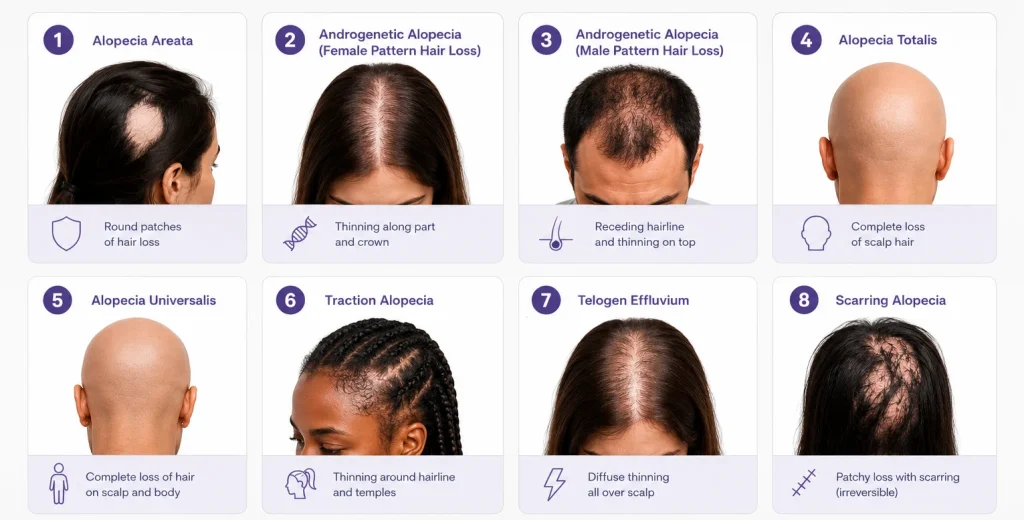
The main types of alopecia most relevant to hair transplant candidacy are the following:
Androgenetic Alopecia
Androgenetic alopecia, commonly called male pattern baldness or female pattern hair loss, is by far the most common and most transplant-friendly form of alopecia.
This condition is caused by genetic sensitivity to dihydrotestosterone (DHT), producing a predictable pattern of recession in men and diffuse thinning in women. DHT gradually shrinks susceptible follicles on the top and front of the scalp. Donor hair, located in the back and sides of the scalp, is genetically stable and resistant to DHT, allowing it to continue growing hair long-term, making this the most hair transplant-friendly form of hair loss.
The follicles at the back and sides of the scalp are genetically programmed to resist DHT, which means they remain stable even as the front and top of the scalp thin. This stability makes these hair follicles reliable donor material and is the foundation of successful hair transplantation.
When a plastic surgeon harvests these follicles, using methods such as robotic FUE, and relocates them to a thinning area, they retain their DHT-resistant characteristics, a phenomenon known as donor dominance. The outcome is both predictable and durable, which is why androgenetic alopecia is the standard for hair transplant candidacy.
Why Pattern Baldness Responds So Well to Hair Transplants
- Predictable hair loss pattern
- Stable donor hair supply
- High graft survival rates
- Long-lasting results
- Ability to combine surgery with medications such as finasteride and minoxidil
For most patients experiencing male or female pattern hair loss, hair transplantation offers one of the most effective and permanent solutions available.
Alopecia Areata
Alopecia areata is an autoimmune disease in which the body’s own immune system identifies hair follicle cells as foreign and attacks them. Unlike androgenetic alopecia, alopecia areata does not create a “safe” donor zone, so even healthy transplanted follicles can become targets of future autoimmune activity.
The challenge for transplantation is that this immune reaction is not localized. Hair follicles can be harvested from a “healthy” donor zone; however, the recipient area may not be an immune-neutral environment and may offer no inherent protection against immune reactions. Thus, even healthy transplanted hair follicles can become targets of future autoimmune activity.
Initial post-operative growth can look promising, but an areata flare during or after the hair transplant growth phase can cause the new hair to shed, just as the original hair did. For patients with alopecia areata, the immune environment of the scalp, not the follicle’s origin, drives the outcome.
However, a small subset of patients with alopecia areata may still qualify. Potential alopecia areata candidates typically have:
- Stable remission for at least 2 years
- No active disease progression, no recent flare-ups
- No immunosuppressive treatment
- Localized, limited stable patch pattern rather than widespread loss
- Mature age where autoimmune activity has demonstrably slowed over time
- Adequate donor density
Stabilizing hair loss before surgery is key to candidacy, as spontaneous remission may occur in up to 80% of patients with alopecia areata within a year without intervention.
Hair transplant eligibility for alopecia requires specialist evaluation and should not be approached as a standard hair loss consultation. Patients should understand that future autoimmune episodes could affect transplanted grafts, and there is no guarantee that these grafts will remain permanently unaffected.
Hair transplant surgery may be considered for carefully selected alopecia areata patients, but outcomes are less predictable than those seen with androgenetic alopecia.
Cicatricial or Scarring Alopecia
Scarring alopecia permanently destroys the structural environment that hair follicles require to survive through chronic inflammation. Inflammation replaces healthy tissue with fibrous scar tissue, which cannot sustain graft survival or new hair growth.
Hair transplantation is generally contraindicated in the presence of active inflammation, as newly transplanted grafts are unlikely to survive. In cases of active scarring alopecia, the ongoing inflammatory activity not only reduces the likelihood of a successful outcome but may also worsen the condition and compromise existing hair.
In carefully selected patients with long-standing, stable and inactive disease, hair transplantation may be considered following specialist evaluation. However, even when the disease appears to have “burned out,” the scarred recipient area remains a challenging environment for graft survival, making outcomes less predictable than in non-scarring forms of hair loss.
A systematic review found hair transplantation in primary cicatricial alopecia had a 76% positive outcome rate. The consensus quiescent (inactive) period required before surgery is 2 years, though documenting true disease inactivity remains difficult. For primary cicatricial alopecia specifically, a longer 2-to-5-year waiting period is recommended before considering surgery, with counseling on the possibility of disease relapse afterward.
Candidates for Hair Transplantation Usually Require:
- No signs of active inflammation
- Disease stability for at least 2 years
- Favorable scalp blood supply
- Specialist evaluation confirming inactive disease
Even in stable cases, scarred tissue presents unique challenges because it often has reduced circulation compared to healthy scalp tissue.
For these patients, success depends heavily on physician experience, proper patient selection, and careful surgical planning.
Traction Alopecia
Traction alopecia is caused by chronic mechanical tension on the hair from tight hairstyles.
Common causes include:
- Tight braids
- Weaves
- Extensions
- Tight ponytails
- Certain cultural hairstyles
When identified early, traction alopecia may be reversible simply by eliminating the source of tension, but prolonged tension can result in permanent follicle death.
Traction alopecia progresses in stages; in the early phase, removing the source of tension allows follicles to recover, and surgery is unnecessary. With continued tension over months or years, follicles die permanently. Once follicle death is confirmed and the source of tension has been permanently eliminated, transplantation becomes a reasonable option.
When Hair Transplants Make Sense
Hair transplantation becomes an excellent option when:
- The damaging hairstyle has been discontinued
- Hair loss has stabilized
- Permanent follicle damage is confirmed
- Adequate donor hair remains available
The lifestyle change is a requirement, not a suggestion, as returning to damaging hairstyles after a transplant would compromise the result.
Patients often achieve highly natural and satisfying outcomes because surrounding hair density is usually preserved.
Diffuse Unpatterned Alopecia (DUPA)
Diffuse Unpatterned Alopecia (DUPA) is one of the most important diagnoses to identify before surgery. Unlike typical pattern baldness, DUPA is a variant of androgenetic alopecia where miniaturization spreads across the entire scalp, including the donor area, making transplantation particularly difficult. As a result, donor follicles are already undergoing miniaturization.
This creates a significant problem as transplanted hairs continue to weaken over time because the follicles themselves are genetically affected.
DUPA is distinct from standard androgenetic alopecia because miniaturization does not respect the traditional safe zone at the back and sides of the scalp. In typical male or female pattern baldness, those posterior and lateral follicles remain DHT-resistant and structurally healthy, providing reliable donor material. In DUPA, miniaturization spreads throughout the entire scalp.
A plastic surgeon evaluating alopecia diagnosis in a DUPA patient will find that even the apparent donor zone contains follicles already in the process of weakening and dying. Transplanting those follicles produces a result that degrades over time as the grafts continue to miniaturize in their new location.
Why Surgery Is Usually Avoided
- No stable donor zone
- Increased risk of poor growth
- Progression continues after transplantation
- Results often deteriorate over time
For these reasons, reputable hair restoration surgeons generally advise against transplantation in true DUPA patients.
Who Is a Good Candidate for a Hair Transplant With Alopecia?
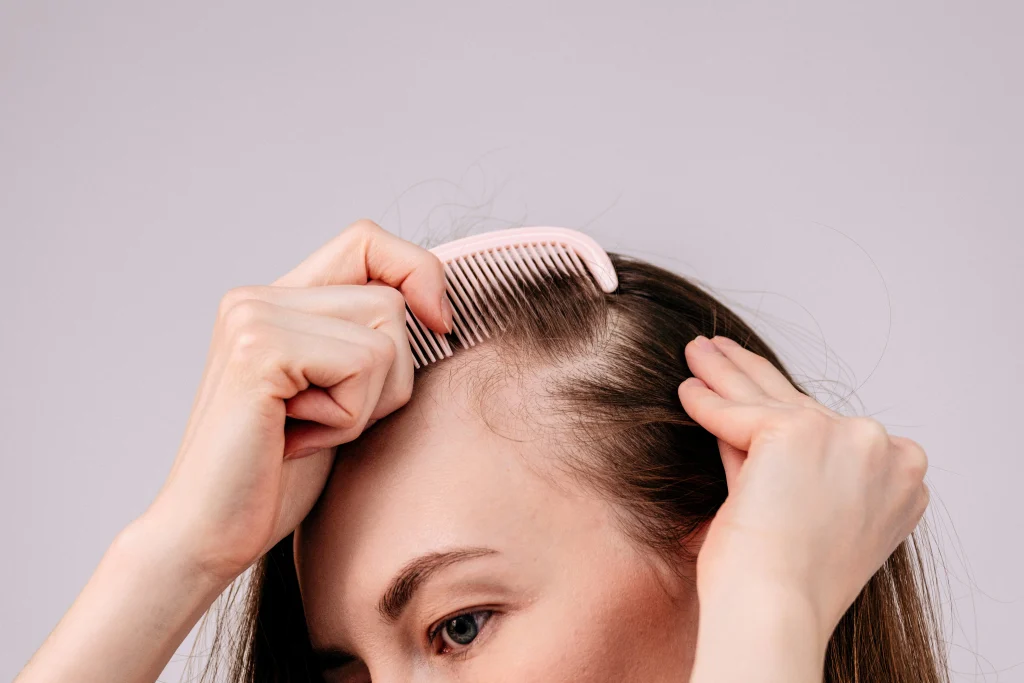
A good hair transplant alopecia candidate is someone with stable, non-progressive hair loss and sufficient healthy donor hair. Regardless of alopecia type, plastic surgeons evaluate candidacy against several specific clinical criteria. The best candidates share several important characteristics regardless of their diagnosis.
Stable hair loss pattern: Active or progressing hair loss is a contraindication. If surrounding non-transplanted hair continues to fall after surgery, the overall cosmetic result will decline even if the transplanted grafts survive. Stability is typically defined as no measurable loss for at least 12 months; this threshold is a general guideline; cicatricial and autoimmune forms of alopecia require longer periods of stability.
Adequate healthy donor hair density: The back and sides of the scalp must contain enough healthy, dense follicles to support the number of grafts needed for meaningful coverage. A plastic surgeon will assess both the quantity and quality of donor hair before proceeding.
Scalp health: No active infection, inflammation, autoimmune flare or significant scarring should be present in either the donor or recipient zones at the time of surgery.
Age considerations: Patients younger than 25 to 30 years old present a higher risk and require more careful planning as the full extent of their hair loss pattern has not yet developed. Transplanting too early can result in an unnatural appearance as surrounding hair continues to thin.
Miniaturization thresholds: Miniaturization refers to the process by which follicles produce progressively thinner and weaker strands before dying. Clinically, 15% miniaturization in the donor zone is considered a warning sign. At 35% or more, donor zone miniaturization becomes a contraindication, as those follicles are unlikely to produce durable results after transplantation.
Realistic Expectations: Hair transplantation improves density and coverage, but it does not create new hair follicles or stop all future hair loss.
For the complete list of disqualifying conditions beyond alopecia type, see who is not a good candidate for a hair transplant.
Tools Used to Determine Hair Transplant Candidacy
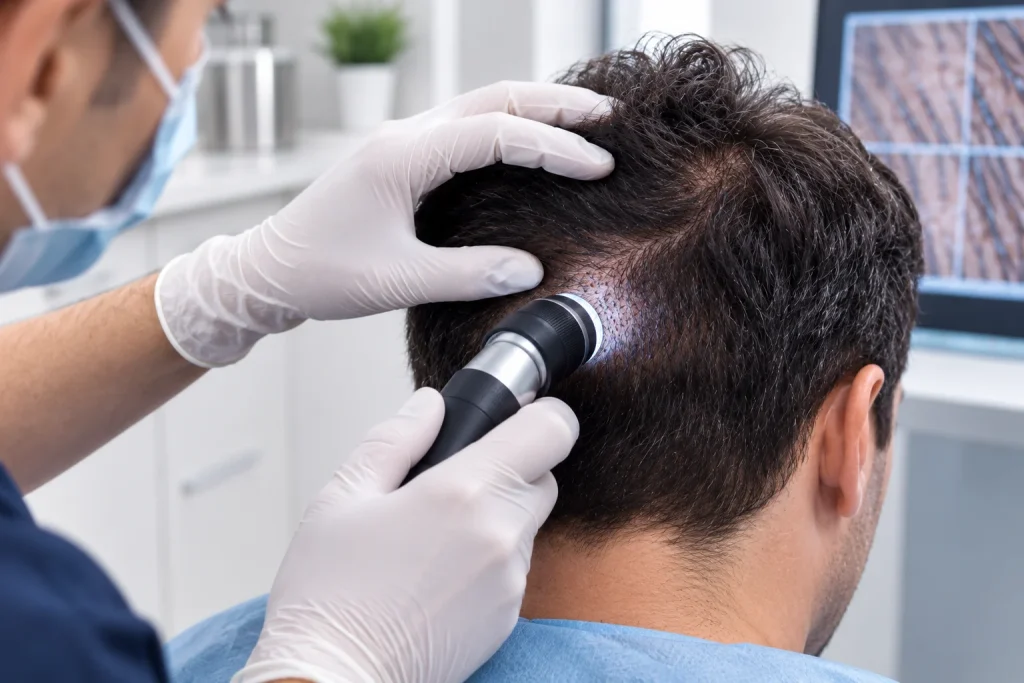
A proper candidacy evaluation goes far beyond a visual examination. Diagnostic tools used for determining candidacy for hair transplants in alopecia patients include:
- Dermoscopy: Allows a plastic surgeon to examine follicle structure, scaling, and miniaturization at a magnified level. It is the primary tool for detecting DUPA, as early-stage miniaturization is not reliably visible to the naked eye.
- Densitometry: Provides objective measurements of follicle density and miniaturization percentage across both donor and recipient zones.
- The hair pull test: A common clinical assessment. If more than 10% of hairs come away when performed by a trained clinician, the alopecia may be in an active stage.
- The SALT score: Measures the percentage of the scalp affected by hair loss, and if it stays consistent over several years, that may indicate stability.
- Medical History Review: Evaluates previous treatments, family history, autoimmune disorders, and disease progression
These tools are essential for correctly placing patients in the appropriate candidacy category, particularly when the answer is not obvious from a surface examination alone. These diagnostic tools help prevent poor surgical outcomes and ensure every patient receives the most appropriate treatment recommendation.
Hair Loss Medical Treatments vs. Surgery: Which Option Fits Your Alopecia Type?
Hair transplant surgery for patients with alopecia is not always the right first step, and for some alopecia types, it should never be the starting point. A practical decision framework by alopecia type helps clarify the sequence of options.
Androgenetic alopecia: For mild-to-moderate loss, minoxidil and finasteride are appropriate first-line treatments. Both have documented efficacy in slowing progression and supporting regrowth in early-stage cases. For advanced or long-stable loss, hair transplant surgery is appropriate and may be used alongside ongoing medical therapy to preserve non-transplanted hair.
Alopecia areata: Medical management is typically the first-line treatment. Current options include topical and injectable corticosteroids, topical immunotherapy, and JAK inhibitors, a newer class of medication that has shown meaningful response rates in moderate-to-severe alopecia areata cases. Surgery enters the discussion only in the narrow remission scenario described earlier in this guide.
Cicatricial /Scarring alopecia: Active cicatricial alopecia requires medical management to arrest inflammation before any surgical option is considered. Anti-inflammatory medications, antibiotics, and immunosuppressive agents are used depending on the specific subtype. Only after the disease has been fully inactive for a documented period can transplant candidacy be assessed.
Traction alopecia: Eliminating the source of tension is the mandatory first step. If loss is recent and follicles have not yet died, regrowth may occur without further intervention. If permanent follicle death is confirmed after lifestyle change, transplantation becomes appropriate.
The most successful hair restoration plans frequently combine surgical and non-surgical approaches, such as ongoing minoxidil alongside transplantation. These combinations are standard practice in androgenetic alopecia and reflect how medical and surgical tools can work together to maximize long-term results
Why Psychological Readiness and Realistic Expectations Matter Before Surgery
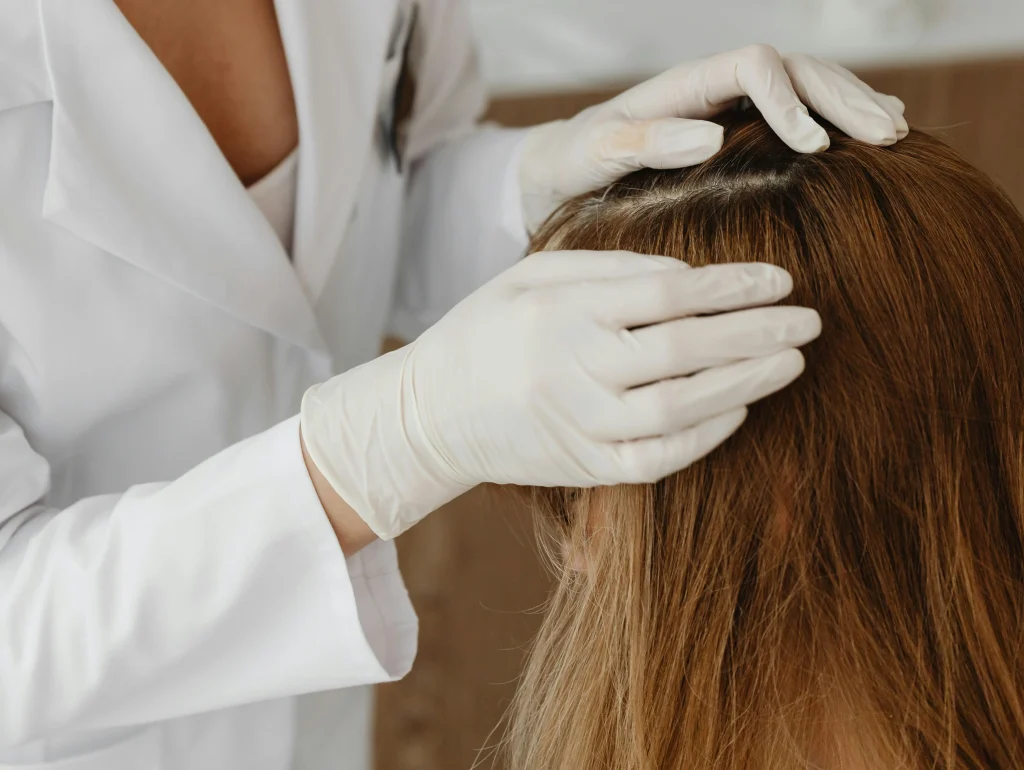
Identifying contraindications to transplantation, such as psychological unreadiness, is a legitimate and clinically important part of pre-operative evaluation. Reputable plastic surgeons assess not only the scalp but the patient’s motivations, expectations, and psychological relationship with their hair loss.
When determining hair transplant candidacy, two specific conditions function as clinical contraindications.
- Body dysmorphic disorder (BDD) involves an intense preoccupation with a perceived physical flaw that may not be visible to others or may be significantly exaggerated. Patients with unaddressed BDD are unlikely to achieve satisfaction from surgical outcomes regardless of the objective quality of results, which is why responsible screening for this condition is standard practice in cosmetic surgery.
- Trichotillomania, or compulsive hair pulling, is an active contraindication because the behavior causing hair loss is ongoing. Surgery cannot produce lasting results when the source of damage has not been addressed.
Beyond these clinical screening points, expectation calibration is essential for every patient. Hair transplantation redistributes existing follicles from one area to another. It does not generate new hair, increase total follicle count, or permanently halt loss in non-transplanted areas. Future thinning outside the transplanted zone may continue, and patients should be aware of this before proceeding.
Weighing these realistic outcomes is worth doing before scheduling surgery. See is hair transplant surgery worth it for a full breakdown.
Get a Professional Hair Transplant Consultation Today
According to the American Hair Loss Association, androgenetic alopecia affects approximately 35 million men in the U.S. By age 35, two-thirds of American men experience some noticeable hair loss, and by age 50, roughly 85% have significantly thinning hair. For women, androgenetic alopecia affects an estimated 30 million women nationwide.
Whether people with alopecia are candidates for hair transplants depends entirely on the type of alopecia present, the stability of the condition, and the health of the donor zone. Some forms of hair loss, particularly androgenetic alopecia, respond well to hair transplantation. Others, including active alopecia areata and scarring alopecia, require medical management first or may not be appropriate for surgery at all.
There is no single yes-or-no answer to this question. It requires an individualized clinical assessment that accounts for diagnosis, disease history, scalp health, and patient expectations. A formal evaluation by a qualified plastic surgeon is the only way to determine which path is best suited to a given situation.
Why Choosing an Experienced Hair Restoration Surgeon Matters
Not every physician performing hair transplants has extensive expertise diagnosing complex alopecia conditions.
Accurate diagnosis is critical because performing surgery on the wrong candidate can lead to disappointing outcomes, graft loss, or progressive thinning after transplantation.
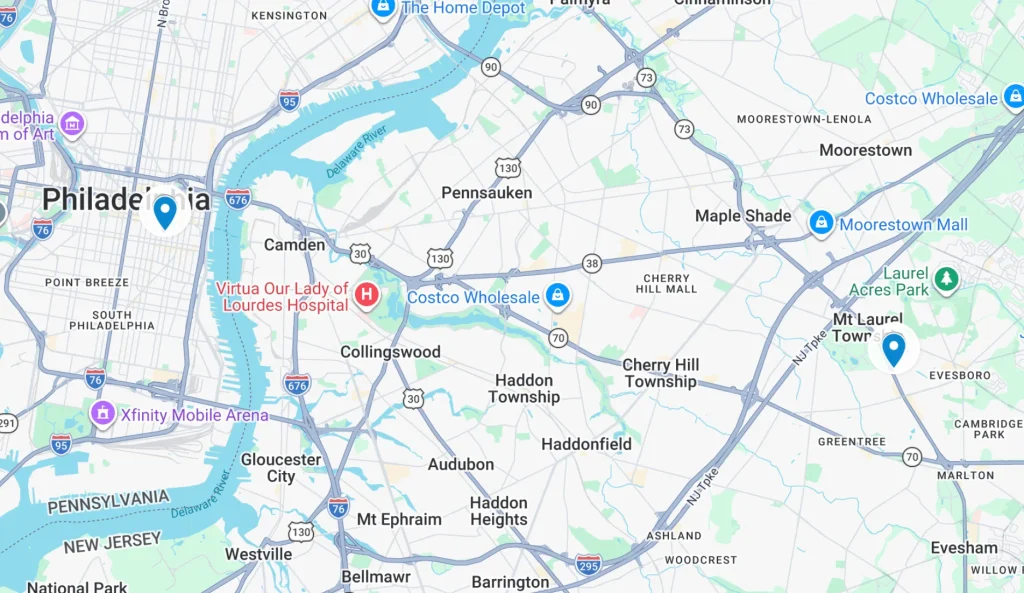
Patients seeking hair restoration in Philadelphia and Cherry Hill choose Dr. Adrian Lo because of his:
- Board-certified plastic surgery training
- Expertise in advanced FUE hair transplantation
- Comprehensive candidacy evaluations
- Personalized treatment planning
- Commitment to natural-looking results
- Focus on long-term hair restoration strategies rather than one-size-fits-all solutions
The goal is not simply to perform a hair transplant. The goal is to determine the treatment most likely to deliver lasting, natural, and aesthetically balanced results.
Schedule a Hair Transplant Consultation in Philadelphia
If you’re experiencing alopecia and wondering whether a hair transplant is possible, the answer depends on your diagnosis, donor hair quality, and long-term hair loss pattern.
The only way to know for sure is through a comprehensive evaluation from an experienced hair restoration specialist.
Patients seeking hair loss treatment in Philadelphia, Cherry Hill, and the surrounding region who want to know whether hair transplant surgery is right for their type of alopecia can schedule a consultation with Dr. Adrian Lo for a personal hair loss consultation and to learn whether hair transplant surgery is the right solution for their alopecia.
FAQs about Alopecia and Hair Transplants
Does Hair Transplant Work for Alopecia Areata?
Only in narrow cases. Because alopecia areata is autoimmune rather than pattern-based, there’s no guaranteed safe donor zone and transplanted hair can shed just like the original hair did. Some patients with two or more years of stable remission may be considered candidates, but there is no guarantee results will last.
What Types of Alopecia Qualify for Hair Transplants?
Androgenetic alopecia (pattern baldness) is the strongest candidate. Alopecia areata, cicatricial alopecia, and traction alopecia may qualify only under specific, narrow conditions. DUPA generally doesn’t qualify, since miniaturization affects the donor zone as well.
Who Is a Good Candidate for Hair Transplants?
A good candidate has a stable, non-progressing hair loss pattern, sufficient healthy donor hair, no active scalp infection or inflammation, and realistic expectations about the results.
Can You Get a Hair Transplant With Alopecia?
Yes, depending on the type and stability of the condition. Androgenetic alopecia responds well to transplantation, while autoimmune and scarring types require a documented period of stability and specialist evaluation first.
Will Hair Transplant Work With Autoimmune Hair Loss?
Not reliably. Autoimmune hair loss, like alopecia areata, can affect any area of the scalp at any time, including transplanted grafts, so outcomes are unpredictable even in stable cases.
Is Transplant Suitable for Alopecia Totalis or Universalis?
Generally not. These are more extensive forms of alopecia areata with the same unpredictable immune activity, and there is no reliable safe donor area to draw from.