

Medically Reviewed By: Dr. Adrian Lo, M.D., FACS, FRCS(C)
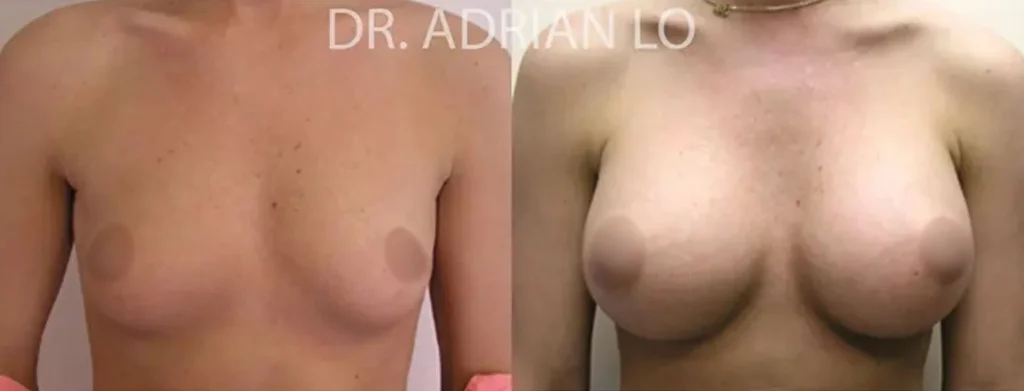
Quick Answer: Which Incision Is Best for Breast Augmentation?
Most plastic surgeons consider the inframammary incision the standard breast augmentation approach because it provides direct implant access and works with saline, silicone, and gummy bear implants and can often be reused for future revision surgery.
However, patients who want no scar on the breast itself may be excellent candidates for endoscopic transaxillary breast augmentation, a specialized technique performed through the armpit. Ultimately, the best breast augmentation incision depends on breast anatomy, implant type selection, long-term goals, and surgeon expertise.
- Transaxillary breast augmentation (armpit): For patients who want no incision on the breast itself and are working with a plastic surgeon skilled in the endoscopic technique, like Dr. Adrian Lo.
- Inframammary: Most commonly used incision and allows direct access.
- Periareolar: Often heals well at the junction of normal breast skin and the pigmented areola.
- Transumbilical (TUBA): Patients seeking a saline-only option with the incision hidden away from the chest.
Why Dr. Adrian Lo Is Different
While many plastic surgeons primarily perform breast augmentation through inframammary incisions, Dr. Adrian Lo has extensive experience with endoscopic transaxillary breast augmentation, allowing qualified patients to achieve breast enhancement without an incision on the breast itself.
A five-year review of Dr. Lo’s practice found that 76% of breast augmentation patients chose the transaxillary approach, demonstrating both patient demand and substantial experience with this specialized technique.
Best Breast Augmentation Incisions at a Glance
- Best overall for most patients: Inframammary incision
- Best for avoiding a breast scar: Transaxillary incision
- Best for scar camouflage: Periareolar incision
- Most remote incision location: Transumbilical (TUBA)
- Best incision depends on: Anatomy, implant type, scar preferences, surgeon experience, and goals
Comparing Breast Augmentation Incisions
| Incision | Location | Implant Compatibility | Key Consideration |
| Inframammary | Crease under the breast | Saline, silicone, and Gummy Bear | Most common approach; direct access, excellent implant control; incision located within the breast fold |
| Periareolar | Border of the areola | Saline, silicone, and Gummy Bear | Blends into areola pigment; may result in raised incision line and affect future breastfeeding |
| Transaxillary (armpit) | Natural crease of the armpit | Saline, silicone, and Gummy Bear | No scar anywhere on the breast; requires endoscopic expertise. |
| Transumbilical (TUBA) | Navel | Saline, silicone possible | Incision farthest from the breast; least commonly performed |
Pros & Cons of Which Incision Is Best for Breast Augmentation
No single incision is best for every breast augmentation patient. The right choice depends on implant size and type, breast anatomy, and how much a patient wants to avoid a visible incision line on the breast. Below are the gains and trade-offs of each incision type.
Transaxillary Incision (Through the Armpit)
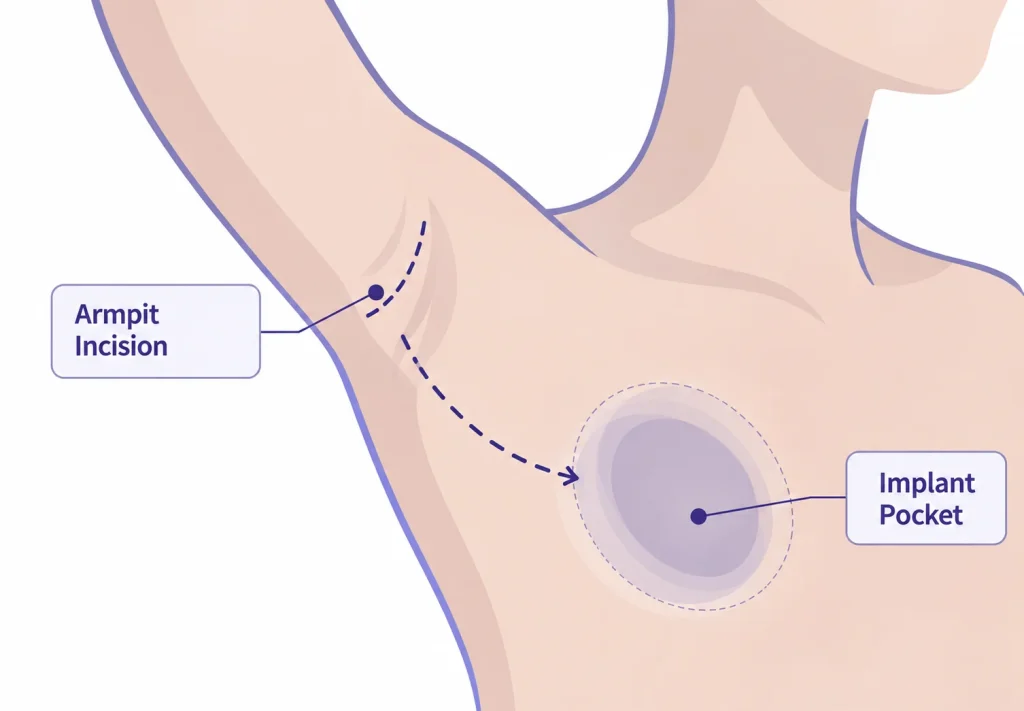
The transaxillary incision is placed in the natural armpit crease. The implant is guided through a tunnel into the breast pocket, leaving no incision on the breast itself. Dr. Lo has developed a specialized focus on endoscopic transaxillary scarless breast augmentation, offering this approach to patients seeking a hidden-incision option in Philadelphia and Marlton.
Older, blind transaxillary techniques were primarily used with saline implants. Modern endoscopic transaxillary breast augmentation uses a small camera for enhanced visualization and can be performed with silicone gel implants. A 2024 study of 1,389 patients reported low complication rates (6.69%) with this technique using smooth, round silicone gel implants ranging from 180cc to 800cc.
A five-year review of Dr. Adrian Lo’s practice (2021-2025) found that 76% of breast augmentation patients chose the transaxillary approach. Of those implants, 96.4% were silicone and 3.6% were saline, with an average implant volume of 388cc. The overall revision rate was 4.8%, reflecting consistent outcomes in a high-volume setting.
The main trade-off with the transaxillary incision is that outcomes depend on a plastic surgeon’s experience with the endoscopic technique and, as with other incision types, the original access point may not be reusable for every future revision.
Inframammary Incision (Under the Breast)

The inframammary incision is placed within the natural fold or slightly above where the breast meets the chest wall. It remains the most frequently used breast augmentation incision in the United States. Because the incision is close to the implant pocket, a plastic surgeon has direct visibility and control during implant placement.
The resulting scar is well hidden by the breast fold and often can be reused for future implant revision surgery.
Periareolar Incision (Around the Areola)
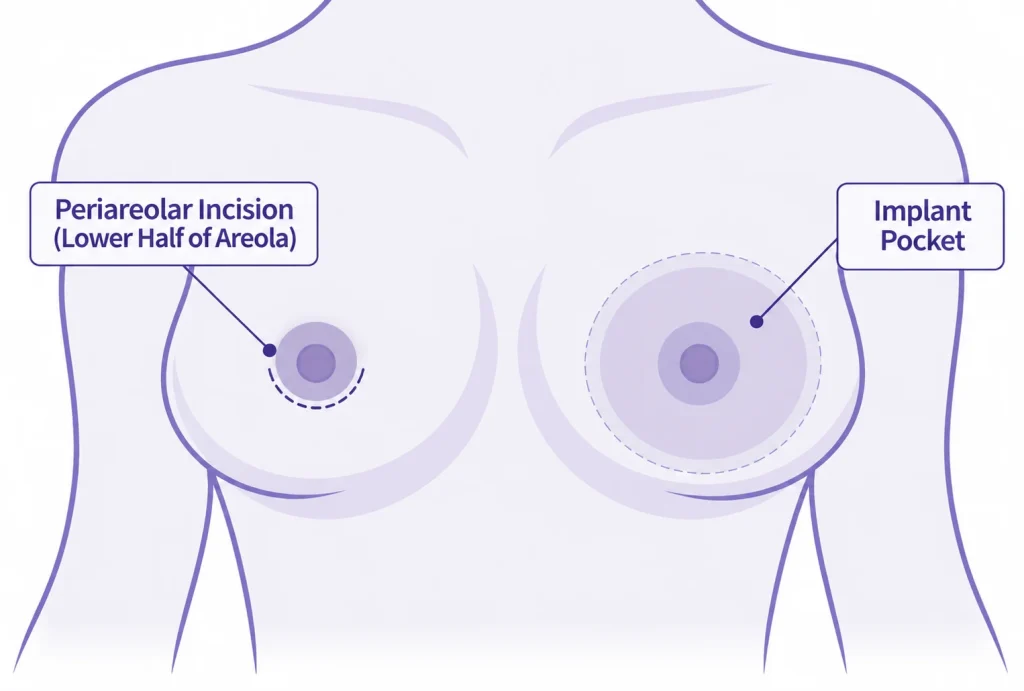
A periareolar incision is placed along the lower border of the areola, where the darker pigmented skin meets the lighter surrounding skin. This location often camouflages the healed incision line.
The trade-off is a higher chance the incision line will heal raised or be more visible. This incision can potentially affect the milk ducts. Candidacy for this incision depends on individual anatomy.
Transumbilical Incision (Through the Navel)

The transumbilical, or TUBA, incision is placed at the navel, and a deflated saline implant is guided upward through a tunnel to the breast pocket before being filled in place. Because this incision is farther from the breast than other approaches, TUBA is technically demanding and performed less frequently than other breast augmentation approaches. While traditionally associated with saline implants, experienced surgeons may also place silicone implants in select cases.
Dr. Adrian Lo’s Expert Insight
“The best incision is not the same for every patient. While the inframammary incision remains the most commonly used approach, many appropriately selected patients can achieve excellent results with an endoscopic transaxillary technique that avoids a scar on the breast itself.”
What Determines Which Incision Is Right for You
- BMI and existing tissue: More natural tissue coverage gives more incision options; very thin patients may have fewer choices.
- Inframammary fold definition: A well-defined fold supports an inframammary incision; a poorly defined fold may steer toward another approach.
- Degree of ptosis (sagging): More significant sagging often calls for combining augmentation with a breast lift, which affects incision choice.
- Chest length or height: Longer or shorter chest proportions can influence pocket access and which incision achieves symmetry.
- Breast asymmetry: Uneven breasts may need different techniques on each side to achieve a balanced result.
- Future breastfeeding plans: Rules out incisions that risk milk duct involvement (periareolar).
Dr. Lo evaluates all of these factors in person during a consultation before recommending an incision.
How Dr. Lo Helps Patients Choose the Right Incision
Dr. Adrian Lo has been board certified since 1991 through both the American Board of Plastic Surgery and the Royal College of Physicians and Surgeons of Canada. He is a Fellow of the American College of Surgeons (FACS) and the Royal College of Surgeons of Canada (FRCS(C)). Newsweek recognized him as one of America’s Best Plastic Surgeons in 2021, 2023, 2024, 2025, and 2026.
During your consultation, Dr. Lo evaluates your anatomy and implant options and determines whether an inframammary, periareolar, transaxillary, or transumbilical approach best suits your aesthetic goals. 3D Vectra imaging is available to help visualize how different implant sizes and placements may look. All procedures are performed at the Pennsylvania Hospital Tuttleman Surgery Center, where physician anesthesiologists are present for your procedure.
Patients can view Dr. Lo’s scarless breast augmentation before-and-after gallery to compare outcomes across incision types.
Ready to Learn Which Breast Augmentation Incision Is Right for You?
Patients travel from Philadelphia, the Main Line, Cherry Hill, Marlton, and throughout South Jersey for consultation with Dr. Lo.
Schedule a consultation with Dr. Adrian Lo to determine which breast augmentation incision best fits your anatomy, implant goals, and scar preferences.

Frequently Asked Questions
What Is the Most Common Incision in Breast Implants?
The inframammary incision, placed in the crease under the breast, is the most common choice. It remains the preferred approach for more than 64% of plastic surgeons in the United States because it allows direct visualization of the implant pocket during placement.
What Is the Newest Breast Augmentation Technique?
Endoscopic-assisted transaxillary augmentation is among the newest refinements. It uses a small camera through an armpit incision for precise pocket creation, and unlike older blind techniques, it can accommodate silicone and gummy bear implants in addition to saline.
What Type of Breast Implant Feels the Most Realistic?
Silicone gel implants, particularly form-stable “gummy bear” implants, are widely considered to feel closest to natural breast tissue. Saline implants can feel firmer or ripple more noticeably, especially in patients with thinner tissue coverage.
How Long Does It Take for a Breast Augmentation Incision to Heal?
The incision itself typically closes within one to two weeks, with most visible healing complete by six weeks. The final appearance continues to soften and fade over six to twelve months.
What Is the Best Breast Augmentation Incision?
No single incision is best for every patient. The inframammary incision is the most commonly used approach because it provides direct access and works with all implant types. Patients who want no scar on the breast itself prefer endoscopic transaxillary breast augmentation. The ideal choice depends on anatomy, implant choice, aesthetic goals, and surgeon expertise.