


Quick Answer: What Size Breast Implant Should I Get?
The best breast implant size is not determined by bra cup size alone. The ideal implant should fit your anatomy, complement your body proportions, and deliver the level of fullness you want while maintaining long-term, natural-looking results.
Breast implant sizes are measured in cubic centimeters (cc), not bra cup sizes. While most breast augmentation patients choose implants between 250cc and 450cc, the right size is the one that fits your anatomy and creates balanced, natural-looking results.
At Dr. Adrian Lo’s practice, patients can preview different implant sizes, profiles, and shapes using VECTRA® 3D imaging technology so you can choose your implant with confidence.
Breast Dimensions at a Glance
| Dimension | What It Measures | What It Affects |
| Size (Volume) | Fill amount in cubic centimeters (cc), typically 80cc–800cc | Overall breast size and approximate cup-size change |
| Profile | How far the implant projects forward relative to its base width | Cleavage, projection and upper pole fullness |
| Shape | Round vs. anatomical (teardrop) | Breast contour and slope. Round implants carry no rotation risk; teardrop implants mimic a natural upper-to-lower breast slope |
| Cohesiveness | How firmly the silicone gel molecules are cross-linked, from softer gel to highly cohesive “gummy bear” gel | Firmness, shape retention over time, and how the implant behaves if the shell is ever compromised |
| Implant Type | Silicone gel vs. saline fill | Softness and natural feel (silicone) vs. firmness and easier rupture detection (saline) |
| Placement | Subglandular, submuscular or dual plane, subfascial position relative to the chest muscle | Appearance, projection, recovery time, wrinkling or rippling visibility, capsular contracture rates, breastfeeding and mammogram imaging quality |
At Dr. Adrian Lo’s practice, we specialize in personalized breast enhancement procedures, including scarless breast augmentation using the transaxillary technique, serving patients across Philadelphia, Pennsylvania, Cherry Hill, New Jersey, and Delaware.
Understanding Breast Implant Sizes
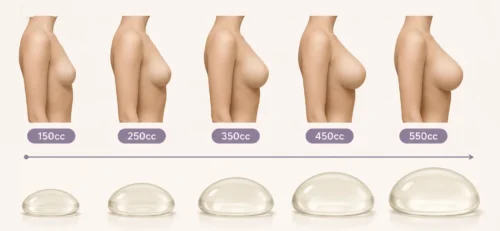
Breast implant size is measured in cubic centimeters (cc). Most patients choose implants between 250cc and 450cc, although sizes can range from approximately 80cc to 800cc.
Implant Size and Typical Appearance
| Implant Size (cc) | Typical Appearance |
|---|---|
| 150–200cc | Subtle enhancement |
| 250–300cc | Natural increase |
| 325-400cc | Fuller appearance |
| 450–500cc | Significant enhancement |
| 500cc+ | Dramatic volume increase |
Breast Implant Size vs. Bra Cup Size
Many patients search for a breast implant cup size chart, but there is no exact conversion between implant volume and bra size.
Bra sizing varies significantly among manufacturers, and the same implant volume can look very different depending on a patient’s starting breast tissue or size, chest width, and skin elasticity.
The table below is a rough reference only and should not replace a personalized evaluation by a board-certified plastic surgeon.
Breast Implant CC to Cup Size Chart
| Implant Volume (cc) | Approximate Cup Size Change |
| 150–200cc | Approximately +1 cup size from baseline |
| 250–350cc | Often 1-2 cup sizes. Approximately B to C cup depending on starting tissue |
| 400–500cc | Often 2-3 cup sizes. Approximately C to D cup in many cases |
| 500cc+ | Frequently D cup or larger |
How Breast Implant Sizes Differ: Profile, Shape, and Diameter Explained
Implant volume is only one factor. Final results are also influenced by implant diameter, profile, shape, and cohesiveness.
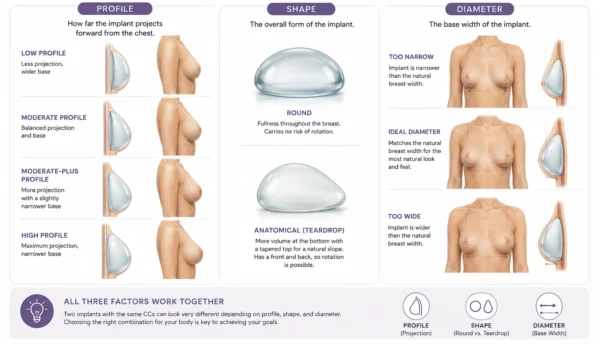
Diameter is the base width of the implant and should fit within the natural breast width to avoid visible or palpable implant edges, wrinkling, and rippling.
Projection describes how far the implant extends forward from the chest. High- or full-profile implants create more projection and cleavage, while low-profile implants produce a wider, subtler appearance.
Shape may be round or anatomical (teardrop). Round implants are most commonly used because they cannot rotate and often provide natural-looking results.
Cohesiveness describes the firmness of the silicone gel. Highly cohesive “gummy bear” implants maintain shape exceptionally well and may reduce visible rippling. Less cohesive implants feel softer, have more movement, and mimic natural breast tissue.
What Implant Profile Means for Your Visual Outcome
Implant profile determines how far the implant projects from the chest wall.
- Low profile: subtle projection, wide base
- Moderate profile and Moderate-plus profile: balanced width and projection, the most commonly selected profiles.
- High or Full profile: greater projection and cleavage with a narrower base.
- Extra or Ultra High profile: maximum projection for selected patients
For a closer look, see our guide to moderate vs. high profile implants.
Silicone vs. Saline: How Implant Type Affects Size, Perception and Feel
Silicone and saline implants with identical cc volumes may look and feel different depending on the implant type.
- Silicone implants remain the most popular option today because they feel more like natural breast tissue and typically show less rippling. Gummy bear implants are a highly cohesive form of silicone implant and are FDA-approved for cosmetic augmentation in patients 22 and older.
- Saline implants are filled with sterile salt water and may feel slightly firmer. Visible rippling is more common in patients with limited natural breast tissue.
Implant Placement and How It Changes the Way Size Looks
Implant placement also affects how size appears.
- Subglandular (above the muscle): More projection and quicker recovery but greater risk of visible rippling and capsular contracture.
- Submuscular/Dual Plane (beneath the muscle): More natural coverage and contour with lower rates of rippling and capsular contracture. One of the most popular implant placements today
- Subfascial: An intermediate option that provides additional tissue coverage without full muscle elevation.
Read more on choosing between subglandular and submuscular placement.
What Size Breast Implants Are Best for You?
A plastic surgeon evaluating implant size will consider multiple factors:
- Existing breast tissue
- Chest width
- Skin elasticity
- Lifestyle and activity level
- Future pregnancy plans
Breast Implant Recommendations by Body Type
- Narrow chest, petite frame: Smaller diameter and moderate to higher profile create noticeable fullness without exceeding the natural breast footprint.
- Broader chest, larger frame: Wider diameter with a low or moderate profile spreads volume naturally, resulting in better proportional balance.
- Minimal existing natural breast tissue: Silicone or highly cohesive gel implants conceal implant edges better than saline on thinner tissue.
- Athletic or active build: Moderate or moderate-plus profiles sit more comfortably during high-impact movement.
- Fuller natural tissue already present: More flexibility in size selection since existing breast tissue provides additional coverage over implant.
The Rice Test: A Practical At-Home Sizing Tool
Some patients use the rice test to estimate implant volume at home. Place measured rice in a zip-lock bag (1 teaspoon of rice equals 5 cc), place it inside a sports bra, and adjust until you achieve your desired look. VECTRA® 3D imaging offers a far more accurate preview of potential surgical results.
Common Breast Implant Sizing Mistakes
- Choosing by cup size. Bra sizing is not standardized; a target cup size will not translate consistently across brands or bodies.
- Choosing an implant that is too large. Implants that exceed a patient’s tissue coverage increase the risk of tissue thinning, long-term wrinkling, rippling, and capsular contracture. An implant that is too large makes revision surgery, if needed, more difficult.
- Ignoring lifestyle. A profile that works well for a sedentary routine can cause discomfort or visibility during running, swimming, or weightlifting.
- Not considering future pregnancy plans. Pregnancy and breastfeeding can change breast shape and aesthetic outcomes after augmentation.
- Skipping sizing technology. Relying only on photos, without trying sizers.
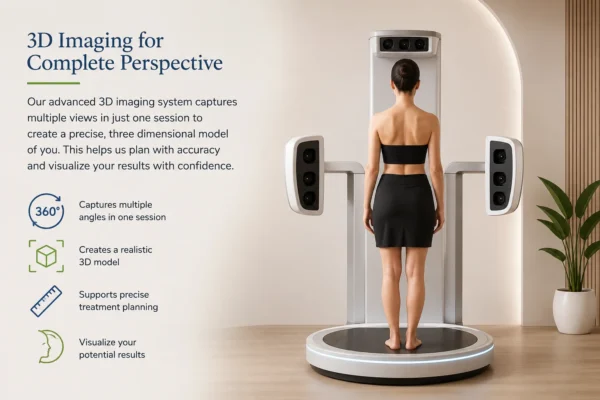
While the rice test can be helpful, VECTRA® 3D Imaging provides a far more accurate way to visualize different implant sizes and potential results before surgery. This is reassuring to patients because it gives them a clear idea of what their post-surgery result may look like.
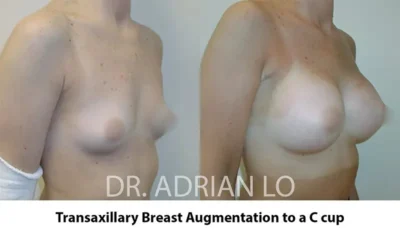
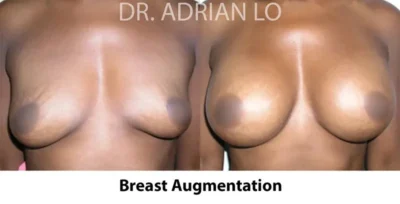
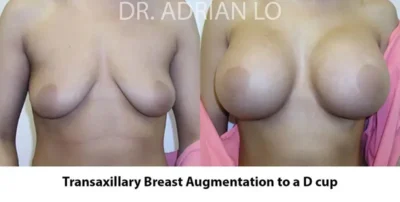
Breast Implant Before and After

Why Patients Choose Dr. Adrian Lo for Breast Augmentation
Choosing the right plastic surgeon is just as important as choosing the right implant. Patients throughout Pennsylvania, New Jersey, Delaware, and the Philadelphia region choose Dr. Adrian Lo because of:
- 30+ years of breast augmentation experience
- Double board certification
- Newsweek recognition as one of America’s Best Plastic Surgeons
- Expertise in scarless transaxillary breast augmentation
- Advanced VECTRA® 3D surgical simulation technology
Dr. Lo evaluates breast dimensions, tissue characteristics, lifestyle factors, and long-term goals to recommend the most appropriate implant for each patient.
Find Your Ideal Breast Implant Size with Dr. Adrian Lo
Choosing the right breast implant size involves more than selecting a cc volume. Profile, implant type, placement, anatomy, and lifestyle all influence the final result.
With expertise in scarless transaxillary breast augmentation and advanced VECTRA® 3D imaging technology, Dr. Adrian Lo provides a highly personalized approach to breast implant selection.
During your consultation, Dr. Lo performs a detailed breast evaluation, discusses your aesthetic goals, uses the advanced VECTRA® 3D imaging technology to help visualize implant options, and recommends the optimal size, profile, and placement for your anatomy, including the transaxillary scarless technique.
Whether you desire a subtle enhancement, restoration of lost volume, improved symmetry, or a dramatic transformation, our team will help you achieve beautiful, natural-looking results tailored to your body.
Schedule your consultation today to learn which breast implant size is right for you.

Frequently Asked Questions About Breast Implant Sizes
How many cc is a C cup implant?
There is no exact conversion. Depending on existing breast tissue and body proportions, many patients require approximately 250cc to 400cc to increase by one to two cup sizes.
What is the most popular breast implant size?
Most breast augmentation patients choose implants between 300cc and 450cc.
Do high-profile implants look bigger?
Yes. A high-profile implant projects farther forward from the chest wall and often appears larger than a lower-profile implant with the same cc volume.