

Breast size varies from person to person and no two individuals develop in exactly the same way. If you’ve ever wondered “Why are my breasts so large?” or “Will breast reduction help me?”, the answer lies in a combination of genetics, hormones, body composition and life stage changes. For some, large breasts develop gradually during puberty; for others, significant changes occur during pregnancy or as a result of certain medications.
Understanding what causes big breasts is the first step toward making informed decisions about your body and your options whether it is lifestyle adjustments, non-surgical relief or breast reduction surgery.
What Causes Big Breasts? The Truth
Several biological factors determine breast size. Most individuals experience a combination of the following biological factors:
- Genetic inheritance
- Hormone levels
- Body Weight and Fat distribution
- Life stage transitions (puberty or pregnancy and breastfeeding)
Clinically, breasts are considered large when they cause physical symptoms or not in proportion with a given frame. Cultural definitions of “large” vary widely and are less meaningful from a health standpoint.
Breast tissue itself is composed of three main components:
- Gland tissue which produces and transports milk
- Adipose tissue or fat
- Connective tissue which provides structural support
The ratio of these components differs considerably from person to person.
Think of breast tissue like a sponge sitting inside a cushion. The sponge represents glandular tissue, the cushion represents fat, and the overall size of both components determines total breast volume. Some individuals have a denser sponge; others have a thicker cushion.
Both combinations can result in large breasts, but the cause and the response to treatment differ for each.

Genetics (The #1 Factor)
Genetics is one of the most influential factors in breast size. If large breasts run in your family, there is a higher likelihood of inheriting similar traits. Much like height or eye color, breast size follows a polygenic inheritance pattern, meaning multiple genes contribute to the outcome.
Breast size is influenced by multiple genes that control:
- Gland tissue development and density
- Fat distribution
- Hormonal sensitivity
Family history alone does not guarantee any particular outcome, but it is a reliable predictor.
Hormonal Levels and Imbalances
Estrogen and progesterone are the primary hormones responsible for breast development, beginning at puberty.
Higher estrogen levels can lead to:
- Increased gland or glandular breast tissue
- Larger overall breast size
- Denser breasts
Certain conditions, such as polycystic ovarian syndrome (PCOS), can disrupt hormonal balance and contribute to breast enlargement.
Body Weight and Fat Distribution
Because breasts contain a significant proportion of fat (adipose tissue), overall body weight can directly affect breast volume. People who carry more body fat and are overweight often have larger breasts. However, this relationship is not always predictable. Some individuals with predominantly gland tissue may have large breasts regardless of their overall weight. This is why some women can lose 20 to 30 pounds and see little to no change in breast size.
Pregnancy and Breastfeeding
During pregnancy, hormonal surges of estrogen and progesterone cause gland tissue to expand in preparation for milk production and breastfeeding. This results in noticeable breast enlargement for most women.
After breastfeeding, breasts may:
- Remain larger than before pregnancy
- Loose firmness due to stretched skin
- Change in shape or volume.
Hormonal changes and breastfeeding can contribute directly to overly large breasts that persist long after the pregnancy period ends.
Medications and Underlying Health Conditions
Certain medications can trigger breast tissue enlargement as a side effect, including:
- Hormone therapies
- Antidepressants or antipsychotics
- Specific blood pressure medications.
Beyond medications, conditions such as hypothyroidism and Cushing’s syndrome can also lead to unexpected breast enlargement.
In rare cases, a condition called gigantomastia causes extreme breast overdevelopment that goes beyond typical variation, a topic addressed in the next section.
When Large Breasts Become a Medical Problem: Understanding Gigantomastia
What causes extremely large breasts? In rare cases, excessive breast growth is caused by gigantomastia, a medical condition characterized by excessive, often rapid breast tissue growth that causes serious physical symptoms.
For patients with severe symptoms, breast reduction surgery is often medically necessary, not just cosmetic. Gigantomastia is defined clinically as breast hypertrophy requiring the removal of more than 1,500 grams of tissue per breast to achieve proportional reduction.
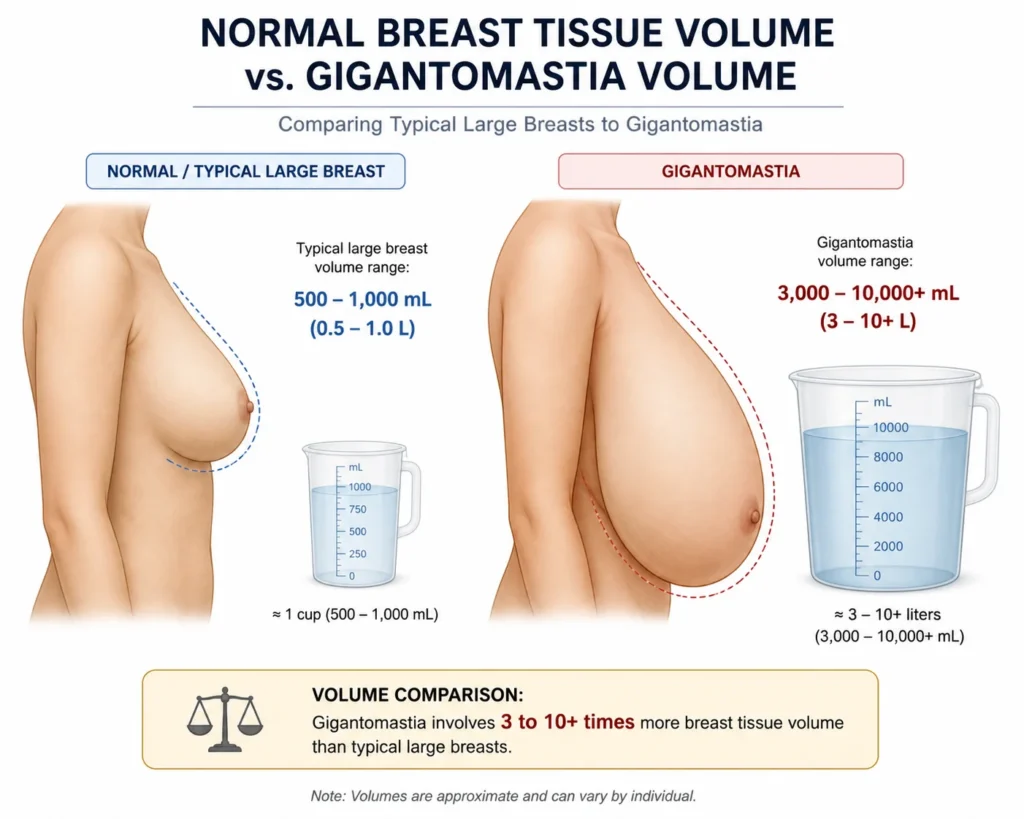
This condition can be triggered by puberty (juvenile gigantomastia), pregnancy (gestational gigantomastia) or certain medications. The causes of disproportionately large breasts in gigantomastia cases are not fully understood, but hormonal sensitivity and genetic predisposition are both thought to play a role.
The physical consequences of gigantomastia extend well beyond appearance.
Common symptoms of gigantomastia:
- Chronic back, neck and shoulder pain
- Skin irritation or rashes, with possible breakdown beneath the breast fold
- Nerve compression causing numbness or tingling in the arms
- Difficulty exercising or breathing comfortably
- Poor posture and daily discomfort
- Inability to wear clothing
Medical professionals note that back pain due to larger breasts can be managed with practical tips and interventions, though in cases of gigantomastia, conservative management often is ineffective and provides only partial relief, and surgical intervention is frequently necessary.
If you are experiencing severe physical symptoms related to breast size, consulting a plastic surgeon is an important step toward getting an accurate diagnosis and exploring your options.
Learn more about how to relieve back pain from large breasts here.
The Overlooked Factor Nobody Talks About: How Breast Composition Affects Size
Two people can weigh the same and have dramatically different breast sizes. Why? The reason comes down to breast composition.
The ratio of glandular tissue to adipose tissue has major implications not just for size but also for how the breasts respond to weight loss, hormonal changes, and surgical intervention. This is also one of the most direct answers to the question of why breasts are large in people who are not overweight.
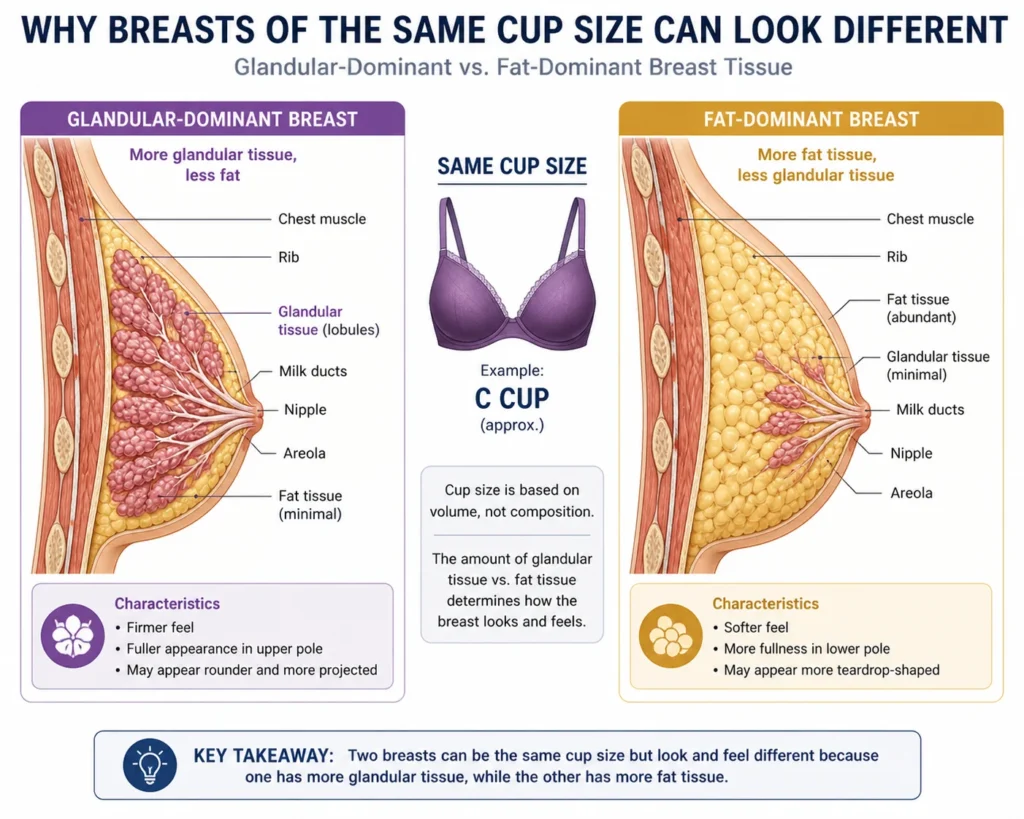
There are three key points worth understanding.
- Glandular-heavy breasts may remain large even after significant weight loss.
- Gland tissue is more dense tissue and does not shrink in response to calorie restriction the way fat tissue does.
- This is why many people find that losing 20 or 30 pounds has little to no effect on their breast size, and it is a biologically grounded reason, and not a personal failure.
- Fat-dominant breasts are more responsive to changes in body weight.
- Fat dominant tissue is softer tissue and breast size is more closely reflected with weight fluctuations, increasing during periods of weight gain and decreasing during weight loss.
- Fat dominant tissue is softer tissue and breast size is more closely reflected with weight fluctuations, increasing during periods of weight gain and decreasing during weight loss.
- Estrogen plays a direct role in regulating this ratio.
- Estrogen promotes gland tissue growth. Individuals with higher baseline estrogen levels may develop denser, more glandular breasts regardless of body weight.
- Overall caloric balance, on the other hand, influences the fat content of breast tissue.
This distinction matters significantly for anyone considering lifestyle changes to address breast size. If your breasts are large despite not being overweight, breast composition is almost always the answer.
Can You Reduce Breast Size Without Surgery?
Non-surgical options for reducing breast size can help, but their effectiveness depends on what is causing the breast size in the first place.
What Can Help:
- Weight loss can meaningfully reduce breast volume, but only if the breasts are primarily fat-dominant.
- Strength Training & Posture Improvement:
- Chest exercises, such as push-ups and chest presses, strengthen the pectoral muscles beneath the breast tissue and may improve posture and overall appearance. However, exercise does not reduce breast volume itself, since muscle development occurs beneath the breast.
- Physical therapy targeting the upper back, shoulders, and core is also a practical intervention for managing discomfort without medical procedures.
- Supportive Bras: Properly fitted, supportive bras and posture correction work can provide meaningful relief from back and shoulder pain associated with large breasts.
- If medication is contributing to breast enlargement, consulting with a physician about alternative medications may be appropriate in some cases.
What Won’t Work:
- Exercise alone can not reduce breast tissue
- Dieting does not affect glandular tissue
For many people, especially those with gland-dominant or significantly large breasts, lifestyle changes have limited impact on breast size. Non-surgical approaches can improve comfort and symptoms, but they do not significantly reduce size. For those individuals, surgical intervention is often the most effective solution.
When Is Breast Reduction Surgery the Right Choice?
Breast reduction surgery may be the best option for individuals whose large breasts affect your daily life and are causing measurable physical or psychological difficulty that has not responded adequately to non-surgical management.
You may be a good candidate for breast reduction surgery if you experience one or more of the following:
- Persistent back, neck, or shoulder pain related to breast weight
- Skin irritation or rashes beneath the breast fold
- Difficulty exercising or other physical activity
- Significant challenges in finding clothing that fit properly
- Self-consciousness or emotional distress related to the size or appearance of the breasts
When there is a documented functional reason for the procedure, including documented pain and posture problems, insurance coverage may be worth exploring with your care team. Coverage criteria vary by insurance provider, but often require evidence of physical symptoms that have not resolved with conservative treatment. Many patients often will proceed to have breast reduction surgery without insurance coverage.
Breast reduction surgery involves removing excess gland tissue, fat, and skin to achieve a breast size that is balanced and proportionate to your body. Because what is proportionate varies by body type and individual goals, this procedure is highly personalized.
Learn more about how much breast reduction surgery costs here.
Does Weight Loss Reduce Breast Size?
Whether weight loss helps reduce breast size depends entirely on breast composition. For fat-dominant breasts, weight loss can produce a meaningful reduction in breast volume. For glandular-dominant breasts, the effect will be minimal, regardless of how much weight is lost.
Here is a practical framework for assessing your own situation:
- If you have lost 20 to 30 pounds and noticed little to no change in breast size, your breasts are most likely gland-dominant.
- If your breast size has tracked closely with weight fluctuations over time, increasing during weight gain and decreasing during weight loss, fat tissue is the dominant component.
Research on breast tissue density consistently supports this pattern, with glandular tissue remaining stable under caloric restriction while adipose tissue decreases, alongside decreases in overall body fat.
One additional consideration: dramatic weight loss can cause breast ptosis (sagging) while reducing overall breast volume. This occurs when the overlying breast skin does not contract or shrink with the loss of breast volume. In these cases, a breast reduction to reduce the size of the breasts will also remove the loose skin (breast lift) to address both concerns simultaneously.
Why Patients Choose Breast Reduction Surgery
Breast size is shaped by a combination of genetics, hormones, body composition, and life changes, and no single factor tells the whole story. Understanding the underlying cause of large breasts, particularly the often-overlooked role of gland versus fat tissue, gives you a clearer picture of what lifestyle changes can and cannot accomplish.
You deserve a body that feels like yours again. Overly large breasts shouldn’t define your comfort, your confidence, or your life. Dr. Adrian Lo has helped countless women in Philadelphia, Cherry Hill, and surrounding areas reclaim all three with expert surgical care and personalized results.
Dr. Lo’s Breast Reduction Surgery Fast Facts:
- Length of Procedure: 2 hrs procedure time.
- Anesthesia: General anesthesia.
- Procedure: Outpatient. Home the same day.
- Recovery: 1 week back to work.
- Learn more about what recovery is like after breast reduction surgery here.
- Customization: A to D cup: choose your size.
- Techniques: Optional no-vertical-scar approach.
- Financing: Available.
All of Dr. Lo’s procedures are performed at accredited hospitals or hospital surgery centers for safety.
Call (215) 829-6900 to learn more today or contact Dr. Adrian Lo to book your consultation!