


Key Takeaway: If you feel a firm, rubbery lump or puffiness under the nipple that does not go away with exercise or weight loss, you may have gynecomastia (true glandular tissue) rather than chest fat. A professional evaluation by a board certified plastic surgeon is the next step.
How Common Is Gynecomastia?
Gynecomastia is very common; various studies indicate up to 50-60% of men experience some degree of gynecomastia at some point in life.
Gynecomastia occurs in:
- Up to 70% of adolescent boys during puberty
- And is highly prevalent in older adults, affecting at least 1 in 3 men over age 50
Despite how common gynecomastia is, many men misdiagnose themselves and attribute these changes to body weight alone. They may try to fix it with diet and exercise, and delay evaluation for months or years.
Here’s how to find out if you have gynecomastia:
- Check for a firm, rubbery lump or a disc-shaped area of tissue behind the nipple.
- It may cause tenderness, swelling, or puffy nipples, and it feels different from soft chest fat.
- A doctor can confirm whether it’s gynecomastia, excess fat (pseudo-gynecomastia) or another condition through a physical exam, hormone testing or imaging.
- See a doctor if you notice a hard or growing lump, nipple discharge, pain or skin changes.
If you have enlarged male breast tissue, often referred to as “man boobs,” and exercise or dieting is not helping, gynecomastia surgery (male breast reduction surgery) removes excess glandular tissue and fat to create a flatter, more masculine chest contour.
What Is Gynecomastia?
Gynecomastia is a non-cancerous enlargement of male breast tissue caused by a hormonal imbalance between estrogen and testosterone.
Unlike chest fat, true gynecomastia involves:
- Dense or firm gland or glandular tissue
- Growth under one or both nipples, often during puberty, aging, or due to obesity, medications, or certain health conditions
- A shape that creates a rounded or “puffy” chest appearance
Important distinction:
- Gynecomastia = Dense, gland tissue (firm)
- Pseudogynecomastia, = excess fat (soft)
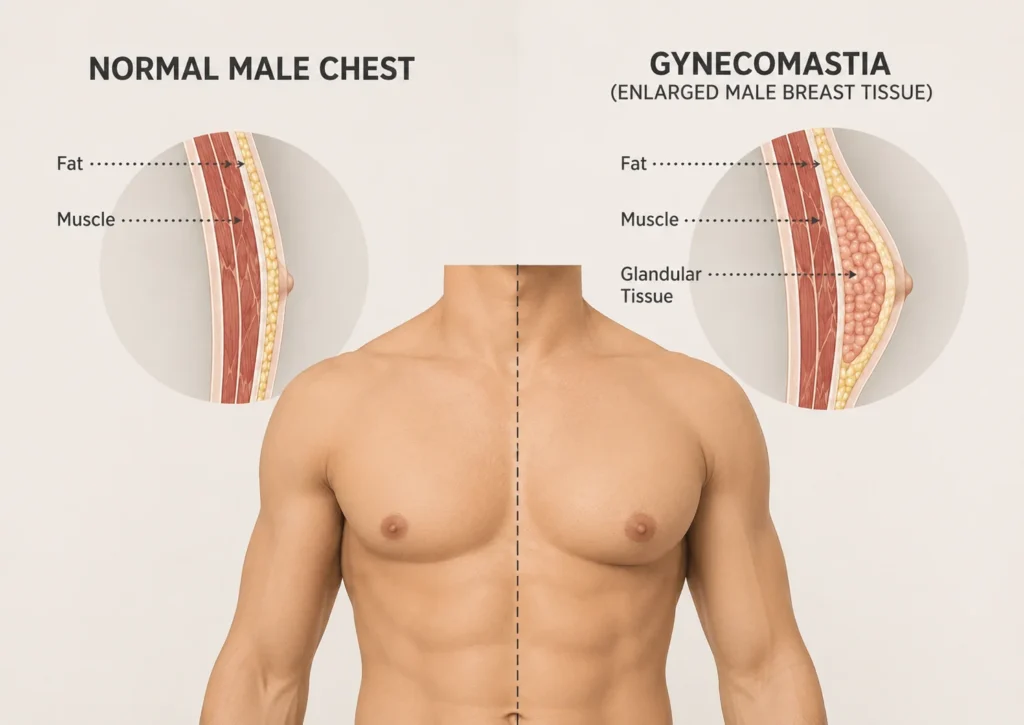
How to Find Out If You Have Gynecomastia: Signs & Symptoms
Gynecomastia symptoms follow a recognizable pattern that sets them apart from general chest fullness. Knowing common visual indicators of enlarged male breast tissue helps you determine whether a consultation with a board-certified plastic surgeon is the right next step.
The signs of gynecomastia include:
Physical Signs
- Enlargement affecting one or both breasts
- Swelling or fullness in the chest area
- A rounded or feminine chest contour
- A firm, dense, rubbery mass located directly under the nipple or areola
- In some cases, tissue feels similar to a pencil eraser or a small grape just beneath the skin’s surface.
- This firmness is what distinguishes it from the softer, more diffuse feel of fat.
Sensations & Symptoms
- Tenderness or heightened sensitivity around the nipple, particularly when pressure is applied
- This sensitivity often coincides with hormonal fluctuations and may come and go
- Discomfort during exercise or when wearing fitted clothing
- Nipples that remain puffy or protrude regardless of body weight or fitness level
Pattern Clues
- Chest remains enlarged even when the rest of your body leans out
- Uneven growth (one side larger than the other)
While most cases of gynecomastia in men are benign cosmetic concerns, symptoms such as nipple discharge, rapidly increasing swelling or bump, skin changes or significant pain warrant prompt medical evaluation to rule out underlying conditions.
The Pinch Test: How to Check for Gynecomastia at Home

The pinch test is the most practical and easiest way to check if you have gynecomastia or chest fat.
How to Do The Pinch Test
- Stand in front of a mirror in good lighting so you can observe any visual differences between sides.
- Place your thumb and forefinger on either side of the nipple, roughly one inch apart.
- Slowly pinch your fingers toward the center of the nipple, applying gentle, consistent pressure as you move inward.
- Feel carefully for a firm, defined mass or disc of tissue directly beneath the nipple. This distinct firmness is the key indicator of glandular tissue → likely gynecomastia
- For comparison, pinch tissue from the outer chest, further from the nipple. If that tissue is uniformly soft with no distinct core, it is likely fat → pseudogynecomastia
A firm, defined area beneath the nipple may suggest glandular gynecomastia, while soft, even tissue with no distinct structure points toward pseudogynecomastia, excess chest fat rather than glandular growth, and any asymmetry between sides is worth noting before your consultation.
The pinch test is a useful screening tool for determining chest fat vs gynecomastia, but it is not a diagnosis. A board-certified plastic surgeon, like Dr. Adrian Lo, can confirm findings through a physical examination and, when appropriate, imaging.
What Causes Gynecomastia (And Why It Matters for Your Approach)
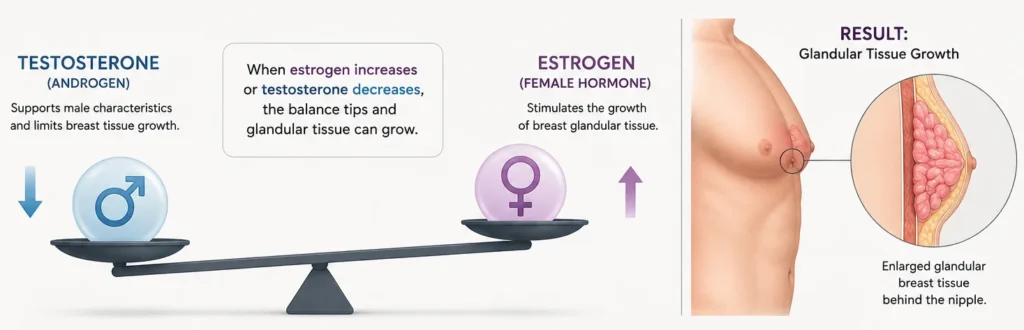
Gynecomastia develops because of a hormonal imbalance, specifically a rise in estrogen relative to testosterone. Think of this balance like a seesaw: when estrogen increases, or testosterone drops, glandular breast tissue can begin to grow.
Natural hormonal shifts during puberty, aging, and even the newborn period are common gynecomastia causes. These cases may or may not resolve on their own depending on timing and severity.
Several medication categories are also associated with male breast enlargement, including:
- Anabolic steroids
- Anti-androgens
- Certain antidepressants
- Some blood pressure medications
If a medication is the source, discontinuing it under physician guidance may reduce tissue growth.
Liver disease, kidney failure, thyroid disorders, and certain tumors can each disrupt hormone levels enough to trigger gynecomastia symptoms. Some studies have linked substances such as marijuana, alcohol, and heroin to hormone changes associated with gynecomastia.
Understanding the cause of gynecomastia matters because it determines the appropriate course of action and whether the condition can resolve naturally. Medication-related cases may improve after the source is removed, while age-related hormonal gynecomastia typically does not resolve without surgical intervention.
Why Diet and Exercise Won’t Fix True Gynecomastia
Glandular tissue does not respond to a caloric deficit or physical training because it is not fat. You can not burn off glandular tissue. Many men spend months, sometimes years, doing chest exercises and cutting calories, expecting the problem to resolve. When it does not, that non-response is actually useful diagnostic information.
How your body reacts to diet and exercise with gynecomastia follows a telling pattern: arms, abdomen, and legs that lean out while the chest stays disproportionately full or the nipple area remains prominent. That inconsistency is a strong indicator of true gynecomastia.
If a man loses a meaningful amount of body fat and his chest flattens uniformly, he likely has pseudogynecomastia.
The pattern that strongly suggests true gynecomastia includes:
- Does not respond to workouts
- Does not improve with dieting
Learn more about whether gynecomastia goes away on its own here.
When to Consider Treatment
If your chest:
- Has remained unchanged for months or years
- Shows a firm lump under the nipple
- Does not improve with weight loss
…. It is time for a professional evaluation
Gynecomastia Treatment: What Actually Works
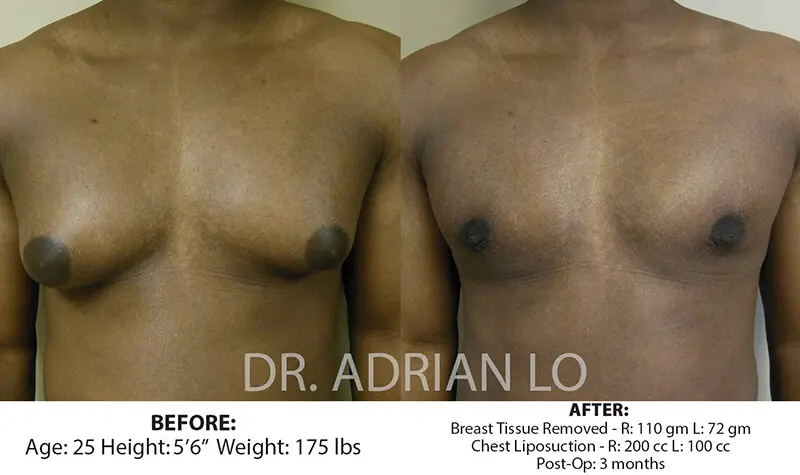
For persistent glandular gynecomastia, surgery is typically the most effective treatment. Gynecomastia surgery, or male breast reduction, removes excess breast tissue and fat to create a flatter, more masculine chest.
Dr. Adrian Lo specializes in gynecomastia surgery in Philadelphia, Cherry Hill, and surrounding areas and treats men with enlarged breasts, puffy nipples, gland tissue, or chest fullness that does not improve with diet or exercise. Dr. Lo’s procedure usually combines liposuction with gland removal and is performed under general anesthesia as an outpatient surgery.
- Most patients return to normal activities within a few days and resume workouts in about two weeks.
- A compression garment is worn for several weeks to reduce swelling and support healing.
- Chest contour improvements are visible immediately, though swelling can temporarily obscure final results.
- Final results develop over three to six months.
- Scars are small and well hidden.
- Risks are minimal but may include swelling, bruising, numbness, or asymmetry.
- Total gynecomastia surgery costs (including plastic surgeon, facility, and anesthesia fees) typically range from $10,500 to $17,000, depending on the treatment needed.
Men who have the signs and symptoms of gynecomastia in their own bodies are encouraged to schedule a consultation with a board-certified plastic surgeon to confirm the diagnosis and develop a personalized treatment plan.
Ready to get started towards achieving your goal of a flatter, more masculine chest?