
Medically Reviewed By: Dr. Adrian Lo, M.D., FACS, FRCS(C)
Yes. Breast implants sitting too high after breast augmentation are typically a normal part of recovery. During the first several weeks, swelling, muscle tightness, and healing tissues can temporarily hold implants higher on the chest before they settle into their final position over three to six months through a process commonly called “drop and fluff.”
Key Takeaways
- Breast implants sitting high right after surgery is normal for most patients, not a complication.
- This early appearance is mainly caused by chest muscle tightness and tissue that has not yet stretched, not by an implant placement error.
- The full settling process, informally called drop and fluff, generally takes three to six months, according to the American Society of Plastic Surgeons.
- It is normal for one side to settle faster than the other; uneven timing between breasts does not usually indicate a problem.
- An implant that keeps rising, or stays unusually firm and painful, past four to six weeks can signal an early capsular contracture and should be evaluated.
Why Do Breast Implants Sit Too High After Breast Augmentation Surgery?
Two factors account for most high-riding implants.
The chest muscle is tight. Pectoral muscle tightness is the most common reason breast implants sit high after surgery. When an implant is placed partially under the pectoral muscle using a dual-plane technique, the muscle can remain tight or spasm in the days following surgery. A tight muscle holds the implant higher on the chest than its intended final position. As the muscle relaxes over the coming weeks, the implant gradually moves into place.
The surrounding tissue has not stretched yet. Skin and soft tissue need time to accommodate an implant, regardless of whether it is placed above or below the muscle. Until that tissue relaxes, the implant cannot settle into the lower breast pocket, which can also make it appear high, round, or slightly square.
The American Society of Plastic Surgeons (ASPS) describes this stage plainly: directly after breast augmentation, implants often ride high. They may look flatter or more square than expected, and this is normal and resolves as the implants settle. Precise pocket creation and implant selection help promote proper settling and long-term symmetry.
In Dr. Lo’s review of 555 consecutive transaxillary breast augmentations performed in his practice between 2021 and 2025, implants sitting too high occurred in just 3.6% of patients and were usually temporary, affecting one side rather than both.
The Drop and Fluff Timeline
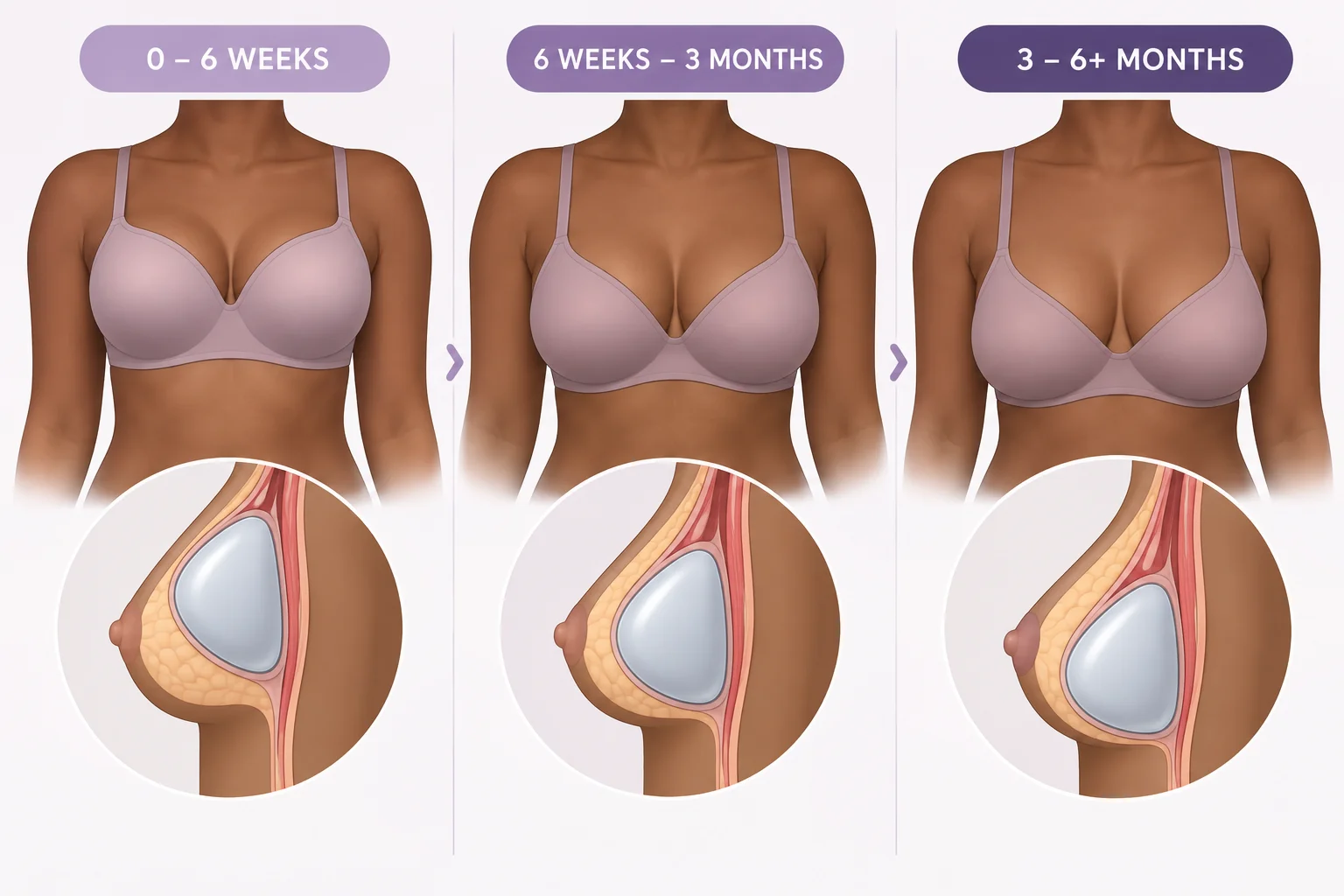
A common question after breast augmentation is, “When will my implants drop?” Surgeons often refer to this settling process as “drop and fluff,” with “drop” describing implant descent, and “fluff” describing softening and filling of the lower breast.
According to ASPS, most implants settle within three to six months, although some settle sooner and others may take up to a year. It is normal for implants to feel still tight or look somewhat high even after most post-surgical swelling has resolved. It is also normal for one breast to settle before the other, since healing does not always progress at the same pace on both sides.
| Breast Implant Settling Timeline | |
|---|---|
| Weeks 1 – 2 | Implants often appear high, firm, and overly full in the upper breast |
| Weeks 3 – 6 | Swelling begins improving Implants may start moving lower |
| Months 2 – 3 | Breasts generally appear softer and more natural |
| Months 3 – 6 | Most drop-and-fluff changes are complete |
Patients considering breast augmentation, including scarless breast augmentation through a transaxillary incision, can review the expected recovery timeline for their specific technique during a personalized consultation.
When Breast Implants Sitting Too High Is Not Normal
Although most high-riding implants improve naturally, persistent implant elevation can occasionally indicate a complication that a board-certified plastic surgeon should evaluate.
Capsular contracture. A soft capsule naturally forms around every breast implant, but in some patients this capsule tightens and thickens, a complication called capsular contracture. Symptoms may include increasing firmness, discomfort, distortion, or an implant that continues rising over time. The Baker classification grades contracture, and peer-reviewed research identifies Baker grade III or IV as the level that typically requires intervention.
Across Dr. Lo’s five-year review, he recorded no cases of Baker grade III or IV capsular contracture, and an overall revision rate of 4.8 percent, both in line with or below rates reported in published, peer-reviewed series of the same procedure.
Because a tightening capsule can push an implant upward, evaluate any implant that continues rising or becomes increasingly firm and painful after four to six weeks.
Implant malposition. In some cases, the implant pocket heals in a way that leaves the implant too high on the chest, a condition known as superior implant malposition.
A 2023 peer-reviewed literature review found that implant malposition requiring reoperation occurs in an estimated 4.7 to 5.2 percent of primary breast augmentations.
In Dr. Lo’s review, superior implant malposition occurred in 20 of 555 transaxillary patients, with 12 patients requiring capsulotomy surgery to release tightened scar tissue and 2 patients converted to a full lift.

Signs to Contact Your Plastic Surgeon
- An implant that continues to rise, rather than gradually lower, past four to six weeks
- Increasing firmness, tightness, or pain in one or both breasts
- Visible distortion of the breast shape
- Significant asymmetry that appears to worsen rather than improve over time
- Redness, warmth, or other signs of infection
- No noticeable settling at all by three to four months
A plastic surgeon can distinguish between normal, temporary tightness and a complication that needs treatment, which is difficult for a patient to assess from the mirror alone.
What Can Help Implants Settle
Recovery instructions vary by patient and procedure.
Although patients cannot force implants to settle faster, following postoperative instructions carefully supports normal healing and helps ensure the implants reach their intended position.
Common elements of post-surgical guidance include:
- Performing implant massage exercises to shape the breast and help the implant settle into the lower position
- Wearing a supportive garment or compression band as directed
- Avoiding underwire bras until cleared
- Limiting upper-body exercise during early healing
- Attending scheduled follow-up appointments
Schedule a Consultation to Discuss Your Recovery
Patients throughout Philadelphia, Cherry Hill, the Main Line, and surrounding Pennsylvania and New Jersey communities frequently ask whether their implants are settling normally during recovery.
If your implants remain unusually high, firm, painful, uneven, or simply not settling as expected, a professional evaluation can determine whether healing is progressing normally and provide peace of mind. Dr. Adrian Lo is a double board-certified plastic surgeon with more than 30 years of experience performing breast augmentation, including scarless breast augmentation through a transaxillary incision, for patients throughout Pennsylvania and New Jersey.
Schedule a consultation to determine whether your implants are settling normally and receive personalized guidance for your recovery.
